Day 225 – Sidekicks: #1, Aaron
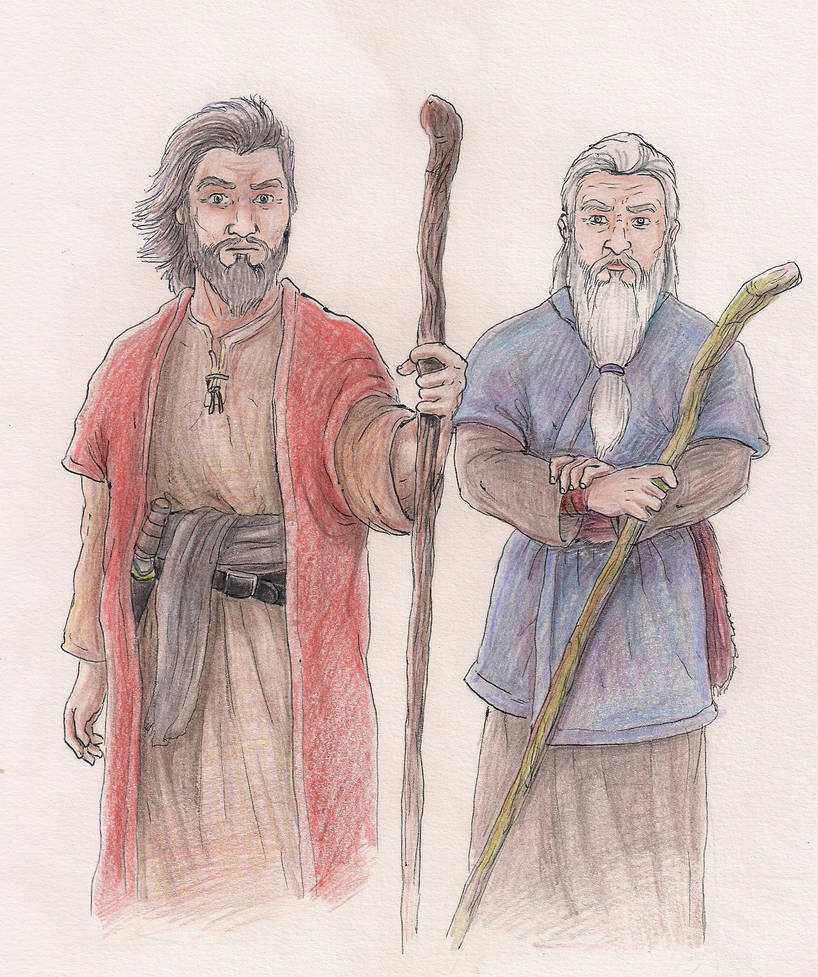
Moses and Aaron by Arauto on deviantrt.com
And no one takes this honour for himself, but only when called by God, just as Aaron was. Hebrews 5:4
Marie Curie the first woman to win a Nobel Prize (1903 for advances in radiation research), the first to win two such prizes, and the only person to win a Nobel Prize in two different scientific fields (Physics and Chemistry) But she could not do this alone – she had a sidekick, her husband Pierre.
All of us are no doubt familiar with the idea of a sidekick. According to the American Heritage Dictionary, a sidekick is a close companion or colleague, a trusted assistant or helper to another person. The last part of the word, kick, is British slang for a front pocket in a pair of pants. That is the safest place for protection from thieves. Over time, the word sidekick came to refer to the closest companion of a person. Batman had Robin, Sherlock Hommes had Dr. Watson, and almost every detective show I watch has an inspector and a subordinate, a mentor and a mentee, a hero and a sidekick. We also find such a person in biblical accounts of famous pairings. Let’s see what we can learn from the lives of biblical sidekicks – beginning with Moses’ sidekick, his brother Aaron.
Aaron’s Strengths
Gifted – It is said that the fear of public speaking is among the top biggest fears people have today. Moses must have had this fear; however, Moses had a brother who was good at public speaking.
“But Moses said to the Lord, ‘O my Lord, I am not eloquent…I am slow of speech and of tongue…’ Then the Lord said to him, ‘Is there not Aaron, your brother, the Levite? I know that he can speak well… He shall speak for you to the people, and he shall be your mouth…’ ” (Exodus 4:10-17), God enabled Aaron and gave him the needed gift.
Willing and obedient – It is one thing to have a gift, but another to use it. We read that Aaron willingly obeyed:
“The Lord said to Aaron, ‘Go into the wilderness to meet Moses.’ So he went and me him at the mountain of God and kissed him. And Moses told Aaron all the words of the Lord with which God had sent him to speak, and all the signs that He had commanded him to do. Then Moses and Aaron went…Aaron spoke all the words…” (Exodus 4:27-31) Notice this: God said ”Go,” so he “went”.
Responsible – We see Aaron assisting Moses along the way. For example, in Exodus 16 the people grumble against the two leaders, who reply that their grumbling is actually against God (“… the Lord has heard your grumbling that you grumble against Him – what are we? Your grumbling is not against us but against the Lord” (v. 8). Moses asks Aaron to gather the people and to supervise the collection of quail and manna, which Aaron does. This and his priestly services, Aaron carries out over many years.
Endorsed by God – In Numbers chapter 16 there is a rebellion against Moses and Aron and in chapter 17 a test is set out. Staffs representing each tribe are set before the Tabernacle and on the next day, Aaron’s staff is the only one that has budded. The people see this endorsement of Aaron and the tribe of Levi as the priestly representatives and are awestruck.
Supportive – A leader needs support, especially from key aids. I recall when I was Interim Director for over two years in an academic department. I am so grateful to several people who enabled me to do my job – an assistant director and staff members responsible for curriculum, finances, student services, public relations, technology, programme management, and more. Similarly, in church ministry, I always had folk who cared for so many aspects of a church’s work – we were a team. In Exodus 17 Moses sent Joshua and the army out to face an enemy in battle. He also chose Aaron and Hur to stand by him. Whenever, Moses held up the staff of God, the army prevailed, but eventually Moses’ arms grew tired. That’s when Aaron and Hur held up Moses’ arms, illustrating their supportive role as helpers to Moses (see Exodus 17).
Privileged – Next we see Aaron given certain privileges. For example, in Exodus 19 the nation is at Mount Sinai and Moses goes up the mountain to get God’s instructions. At one point, he returns down the mountain to caution the people that this is a holy place. God says to Moses, “Go down and come up bringing Aaron with you” (v 24), and in the next chapter God gives Moses the Ten Commandments. Some of the Lord’s servants are given unique privileges in their service for him.
Representative and Advocate – Aaron was appointed as the High Priest, and he and his sons were consecrated in a special service for their priestly role (Exodus 29:9, “…and the priesthood shall be theirs by a statute forever”). As priests, they represented the people before God, offering sacrifices for their own and the people’s sins. Later, in the Book of Hebrews, we see their role compared to that of Jesus who is the Great High Priest who offers Himself as the once-and-for-all sacrifice for our sin (Hebrews 9:11-12, “But when Christ appeared as a high priest of the good things that have come, then through the greater and more perfect tent…He entered once for all into the holy places…by means of Hs own blood, thus securing eternal redemption.”).
Lastly, though Aaron served well in most times, he did, nonetheless, fail significantly on more than one occasion.
Aaron’s Failure and Recovery
His greatest failure is chronicled in Exodus 32. While Moses is on the mountain, the people grow restless and pressure Aaron to make an idol they can worship. He engineers the making of the golden calf. He invites the people to offer sacrifices and pray. They do – then immediately hold a feast, eating and drinking and rising up “to play” (32:6). When Moses confronts them, he especially confronts Aaron, “What did the people do to you that you have brought such a great sin upon them?’ (v. 21) Sadly, Aaron offers a faint excuse about tossing the gold jewelry people gave him into a fire and “out came this calf” (v. 24).
Again, later, Aaron, along with his sister, Miriam, gets involved in a complaint against Moses. They say, “Has the Lord indeed spoken only through Moses? Has He not spoken through us also?” (Numbers 12:2) Miriam is afflicted with leprosy – she seems to bear the greater punishment. Perhaps this suggests that she led the challenge against Moses and Aaron went along. This seems to be his main weakness, evident in going along with the rebellious people earlier in the making of the idol, again here, and in Numbers 20:10-13 when he appears to be guilty along with Moses of striking the rock in anger. For this sin, he is barred from entry to the Promised Land.
Thankfully, we see that Aaron was repentant and that he intervened on behalf of Miriam who became leprous. We read, “And Aaron said to Moses, ‘O, my lord, do not punish us because we have done foolishly and have sinned. Let her not be as one dead…” Num. 12:11-12). In another case, when two sons of Aaron offered an unauthorized fire before the Lord and were struck dead, Aaron respected the seriousness of the offence and of God’s punishment of the sons. We read, “And Aaron held his peace.” (Leviticus 10:3)
Your Turn:
- Read Exodus 4.
- What is your gift? Are you using it? What privileges has God given you? Are you using them to grow in your relationship with God and in your service to others? Which of Aaron’s strengths do you most admire in others?
- What weaknesses are you prone to? Are you willing to confess your sins?
Day 226 – Sidekick #2: Joshua

After the death of Moses the servant of the Lord, the Lord said to Joshua the son of Nun, Moses’ assistant, “Moses my servant is dead. Now therefore arise, go over this Jordan, you and all this people, into the land that I am giving to them, to the people of Israel. Every place that the sole of your foot will tread upon I have given to you, just as I promised to Moses. No man shall be able to stand before you all the days of your life. Just as I was with Moses, so I will be with you. I will not leave you or forsake you. …” Joshua 1:1-5
My late brother was a trumpet player; one of my sons-in-law plays trumpet; and Moses’ sidekick, Joshua, whether or not he played one, nonetheless is associated with the trumpet (which then was probably a ram’s horn or shofar):
8 And just as Joshua had commanded the people, the seven priests bearing the_seven trumpets of rams’__horns before the LORD went forward, blowing the trumpets, with the ark of the covenant of the LORD following them (Joshua 6:8).
Such was the scene at the battle of Jericho – but there is much more than this in the story of Joshua, Moses’ sidekick.
Resumé:
Joshua was born a slave in Egypt (about 1360 BC). He was the son of Nun, in the Tribe of Ephraim. His name means “salvation” and is the Hebrew form of the Greek “Jesus”. He began his career as “assistant” to Moses while “a young man” (Exod. 33:11), and was given the high privilege of accompanying Moses up Mount Sinai where the 10 Commandments were given to Moses on tablets of stone.
Exodus 24:12-13, The LORD said to Moses, “Come up to me on the mountain and wait there, that I may give you the tablets of stone, with the law and the commandment, which I have written for their instruction.” 13 So Moses rose with his assistant Joshua, and Moses went up into the mountain of God.
Exodus 32:17-19 When Joshua heard the noise of the people as they shouted, he said to Moses, “There is a noise of war in the camp.” 18 But he said, “It is not the sound of shouting for victory, or the sound of the cry of defeat, but the sound of singing that I hear.” 19 And as soon as he came near the camp and saw the calf and the dancing, Moses’ anger burned hot, and he threw the tablets out of his hands and broke them at the foot of the mountain.
This amazing privilege continued throughout the wilderness years.
Exodus 33: 11- Thus the LORD used to speak to Moses face to face, as a man speaks to his friend. When Moses turned again into the camp, his assistant Joshua the son of Nun,a young man, would not depart from the tent.
He performed other services to God, Moses, and the people, including being sent to spy out the promised land, then risking his life to urge the people to move forward, and also leading the nation’s army in battle. This served him well when he came to the border and crossed into Canaan and planed the campaign to take control of the promised land.
Numbers 14:6-10 6 And Joshua the son of Nun and Caleb the son of Jephunneh, who were among those who had spied out the land, tore their clothes7 and said to all the congregation of the people of Israel, “The land, which we passed through to spy it out, is an exceedingly good land. 8 If the LORD delights in us, he will bring us into this land and give it to us, a land that flows with milk and honey. 9 Only do not rebel against the LORD. And do not fear the people of the land, for they are bread for us. Their protection is removed from them, and the LORD is with us; do not fear them.” 10 Then all the congregation said to stone them with stones. But the glory of the LORD appeared at the tent of meeting to all the people of Israel.
Exodus 17:8 – 9 8 Then Amalek came and fought with Israel at Rephidim. 9 So Moses said to Joshua, “Choose for us men, and go out and fight with Amalek. Tomorrow I will stand on the top of the hill with the staff of God in my hand.”
His career reached its peke with the crossing of the Jordan and defeat of Jericho, followed by many conquests that lead to possession of the new land. In his 90s, Joshua assumed command of Israel, following the death of Moses. He had proved his worth and now took office as leader of a nation of two million at a defining moment in its history. Joshua lived to 110, having left a great legacy. He is remembered not only as the assistant of Moses, but even more importantly as the servant of the LORD.
Judges 2:7-8 7 And the people served the LORD all the days of Joshua, and all the days of the elders who outlived Joshua, who had seen all the great work that the LORD had done for Israel. 8 And Joshua the son of Nun, the servant of the LORD, died at the age of 110 years.
Joshua Remembered:
There is much more we could say about his career, but in this short space it is tme to sum up some important points about this sidekick:
- Joshua was approved and commissioned for a lifetime of service – and he fulfilled his calling, in effect, gaining a lifetime achievement award. “No man shall be able to stand before you all the days of your life. Just as I was with Moses, so I will be with you. I will not leave you or forsake you.” (Josh. 1:5). “And the Lord commissioned Joshua…and said, ‘Be strong and courageous, for you shall bring the people of Israel into the land that I swore to give them.’” (Deut. 31:23). Also see Judges 2:7-8, quoted above. This should cause us to examine our own progress in the calling God has given us.
- His close relationship to God is seen in his personal faith, Spirit-filled service, and encounters with the Lord and His angelic representative. See Numbers 27:18 (“a man in whom is the Spirit”); Joshua 1:8 (“This Book of the Law shall not depart from your mouth, but you shall meditate on it day and night…”); Joshua 5:13-15 (“When Joshua was by Jericho, he lifted up his eyes and looked, and behold,…the commander of the army of the Lord…And Joshua fell on his face to the earth and worshipped…the place where you are standing is holy.”)
- He was not perfect – e.g., not careful with his acceptance of the Gibeonites who tricked him. This story is found in Joshua 9. The people of Gibeon hatched a plan to trick Israel into allowing them to escape destruction. Joshua and other leaders fell for the deception. Afterward, Joshua kept his word to these people but also punished them by means of a life of servitude to those who tended the altar.
- He absorbed much from his mentor, Moses, and, in turn, passed on much to his successors. References throughout Joshua are made to a leadership team, and in chapter 24, having taken the land, he gathered them together, reminded them of all God had done in freeing them from slavery and giving them the Promised Land, and challenged them: “14 “Now therefore fear the LORD and serve him in sincerity and put away the gods that your fathers served beyond the River and in Egypt, and serve the LORD. 15 And if it is evil in your eyes to serve the LORD, choose this day whom you will serve, whether the gods your fathers served in the region beyond the River, or the gods of the Amorites in whose land you dwell. But as for me and my house, we will serve the LORD.”
What did he challenge those successors to be and do? The same challenge is for us.
- Choose between the gods of this world and one true God (Joshua 24:14,15).
- Trust God to give you what He has promised (Joshua 1:3-5).
- Go to the task God sets before you. (“Now, therefore, arise; go over the Jordan… Joshua 1:2)
- Respect the Lord, the Holy One. (Joshua 5:13-15)
Your Turn:
- Read Joshua 1:1-18 and 24:14-15.
- As you consider your own calling and your record of service to God, ponder these verses: “As each has received a gift, use it to serve one another, as good stewards of God’s varied grace” (I Peter 4:10)“For I know the plans I have for you,” declares the LORD, “plans to prosper you and not to harm you, plans to give you hope and a future.” (Jeremiah 29:11) “Fight the good fight of the faith. Take hold of the eternal life to which you were called when you made your good confession in the presence of many witnesses” (1 Timothy 6:12). [Paul told Timothy] “fan into the flame the gift of God, which is in you through the laying on of my hands. For the Spirit of God gave us does not make us timid, but gives us power, love and self-discipline.”(II_Timothy_1:6,7,8) “I have fought the good fight, I have finished the race, I have kept the ” ( II Timothy 4:7-8)
- Next, consider your own relationship to God – nurture that relationship with the Word of God. “This Book of the Law shall not depart from your mouth, but you shall meditate on it day and night, so that you may be careful to do according to all that is written in it. For then you shall make your way prosperous, and then you will have good success.” (Joshua 1:8)
- Beware of what might trip you up. When you fall, repent, and correct your ways.
- Learn from your mentors and mentor others in turn.
- A resumé is not meant to be a static thing; it is meant to change, grow, expand over the years. Joshua’s certainly did.
Day 227 Sidekicks #3: Barak

Ancient bronze chariot : http://www.sfltimes.com/news/nationalandworld/mysterious-ancient-bronze-chariot-found-buried-with-horse-skeletons
14 And Deborah said toBarak, “Up! For this is the day in which the LORD has given Sisera into your hand. Does not the LORD go out before you?” So Barak went … Judges 4:14
Barak was the sidekick of Deborah. Their story is found in Judges 4 and 5. Between Joshua and Samuel (about 300 years), Israel was led by several “judges”. There were 12 or 13 and they included Gideon and Samson – and one woman, Deborah. She was a godly woman who was sought out for her opinions on various issues – issuing counsel from a specific place: “the palm of Deborah between Ramah and Bethel in the hill country of Ephraim”. She is described as a wife, a prophet, and “a mother in Israel”.
Israel had a repeated record of falling into sins and under the rule of various local rulers. Each time God would raise up a new judge to deliver them. The new judge would rule for 20-40 years, die, and the people would again fall into sinful practices, and into more subordination to Gentile kings, then cry for rescue. By chapter 4, the nation had fallen under the control of a Canaanite king, Jabin, and his military commander, Sisera. Things were desperate, so the people of Israel went to Deborah for help. She needed someone to lead Israel’s armies against Sisera. That’s where Barak entered the picture. In Judges 4:6 we see that she summoned Barak to come from the area we know from New Testament times as Galilee. Deborah then gave Barak the order to gather an army of 10,000 to face Sisera. She would draw out Sisera and she assured Barak saying, “I will give him into your hand (4:7).” She was clearly a woman of faith, seeing that she trusted God for victory, even though Barak’s army was hardly a match for Sisera’s experienced army that was equipped with 900 iron chariots and a 20- year record of cruelty towards Israel (4:3).
What, then, can we say of her sidekick, Barak? He obeyed the call to lead the army of Israel (“… so Barak went”, Judges 4:14). He summoned a fighting force from the northern tribes of Zebulon and Naphtali (4:10 – though Ephraim, Benjamin, & Zebulon are also mentioned in 5:14), and these forces, with God’s help, routed the enemy (we read that God sent rains that slowed the horses and chariots of Sisera, 4:15; 5:4). In I Samuel 12:11 Barak is named as one of God’s sent leaders who delivered Israel to safety. And in Hebrews 11:32 he is mentioned as one who by faith conquered kingdoms, was made strong out of weakness, and put foreign armies to flight. With Deborah, Barak is called a “leader who took the lead” (Judges 5:2). Together with Deborah, he wrote the song of praise recorded in Judges 5, a song that concludes with this verse (31), “So may all your enemies perish, O LORD! But your friends be like the sun as he rises in his might. And the land had rest for forty years.” Thus, through hard work and the risking of his life in battle, good came to the land for four decades.
The only “negative” attached to Barak is in Judges 4:8-9. Deborah challenged Barak to go and he replies that he will do so, but only if she goes with him. This results in Deborah saying that she will accompany him, but the glory for subduing Sisera will be given to a woman. As it turns out the woman is not Deborah but another woman named Jael, a Canaanite who was sympathetic to Israel. When Sisera saw that his army was heading for defeat, he ran on foot and came to Jael’s tent. She offered him a place to hide, a blanket, and a glass of milk. Exhausted, Sisera fell asleep, and Jael took a tent peg and pounded it into Sisera’s skull, killing him. In their song, Barak and Deborah tell her story which ends with the Gentile woman getting the honour that might otherwise have gone to Barak. Barak’s pride is not injured, however, as he joins Deborah in exclaiming, “Most blessed of women be Jael”.
Your Turn:
- Read Judges 4 and 5.
- What character qualities do you see in the two women in these chapters, Deborah and Jael?
- Traditionally, armies are led by men, and especially so at that time in history. Yet, Barak was willing to take orders from Deborah and to co-write a song that included praise of Jael. What can we learn from him about how male and female leaders can work successfully together?
- When you think of the mentor – mentee relationship, regardless genders, what do we learn from this story?
- Judges 5:31 says in part, “[May] your friends be like the sun as he rises in his might.” Jesus used a similar expression in His parable of the weeds (Matthew 13:24-30; explained in 13:36-43). There, Jesus declares that (like Sisera in our passage) evildoers will be punished, but those who will share in His coming kingdom are “the righteous [who] will shine like the sun in the kingdom of their Father.”
DAY 228 – Sidekicks #4: Elisha

9 When they had crossed, Elijah said to Elisha, “Ask what I shall do for you, before I am taken from you. And Elisha said, “Please let there be a double portion of your spirit on me.” 10 And he said,“You have asked a hard thing; yet, if you see me as I am being taken from you, it shall be so for you, but if you do not see me, it shall not be so.” 11 And as they still went on and talked, behold, chariots of fire and horses of fire separated the two of them. And Elijah went up by a whirlwind into heaven.12 And Elisha saw it and he cried, “My father, my father! The chariots of Israel and its horsemen!” And he saw him no more. II Kings 2:9-12
One of the great pairings of God’s servants, found in the Bible, is that of Elijah and Elisha. Elijah means “my God is Yahweh” (i.e., Jehovah). Elisha means “my God is salvation”. Both were mightily used by God in the history of their nation Israel, during the 9th century B.C. Elisha was Elijah’s sidekick and successor.
The story of Elisha begins in I Kings 19:19-21.
19 So he departed from there and found Elisha the son of Shaphat, who was plowing with twelve yoke of oxen infront of him, and he was with the twelfth. Elijah passed by him and cast his cloak upon him. 20 And he left the oxen and ran after Elijah and said, “Let me kiss my father and my mother, and then I will follow you.” And he said to him, “Go back again, for what have I done to you?”21 And he returned from following him and took the yoke of oxen and sacrificed them and boiled their flesh with the yokes of the oxen and gave it to the people, and they ate. Then he arose and went after Elijah and assisted him.
Here we have the calling of Elisha to prophetic service. Elisha is dutifully working on the family farm when Elijah places his cloak on him – a symbol of passing authority. After saying his ‘goodbyes’ and offering oxen as a sacrifice to God, Elisha is off to join Elijah in obedience to God’s call. Obeying God’s leading often means leaving behind some previous ambition or service – leaving, in this case, a quiet life on the farm to the unknowns and dangers of a prophetic ministry. Perhaps you can relate to this in your own walk with God. Elijah witnessed the last phases of his teacher’s ministry, which involved dealings with kings (good and bad) and nations.
Then, in II Kings 2, spiritual leadership passes from Elijah to Elisha. Elisha was determined to stick with his mentor as long as possible. Three times he is offered the opportunity to stay behind while Elijah moves on, and three times Elisha replies to Elijah, “As the Lord lives, and yourself live, I will not leave you” (II Kings 2:2,4,6). Watching from a distance are 50 men of the sons of the prophets as Elijah and Elisha cross the Jordan River (Elijah uses his cloak to part the waters). Elijah asks Elisha what he can do for him “before I am taken from you”. Elisha asks for a double portion of his mentor’s spirit (v. 9) and Elijah responds, “You have asked a hard thing.”
Yet, Elisha was given the “hard thing”. That is indicated in the miracles he did – 14, twice as many as are recorded for Elijah (7) – a “double portion” of Elijah’s spirit. Read II Kings chapters 2-13 to learn about Elisha’s life – some 60 years of ministry which covered the reign of four kings of Israel. The miracles of Elisha included demonstrations of power over nature, healing of nature, judgment on evildoers, confusion of enemy armies, multiplication of a widow’s cooking oil in a time of famine, raising of the dead, healing of a leprous Syrian general, making a helper aware of angelic presence, and various prophetic utterances. And to top it off, after Elisha’s death, the bones of a deceased man were dropped into Elisha’s grave and the man revived – II Kings 13:20-21. The sons of the prophets (no doubt students learning from Elijah and Elisha) observed, “The spirit of Elijah rests on Elisha.” (II Kings 2:15)
Elisha proved worthy of the privilege he was given as Elijah’s assistant. Elisha as sidekick was a man of humility (he “poured water on the hands of Elijah” (II Kings 3:11), and care for people (he wept for the great harm the next king of Syria would do to the people of Israel (II Kings 8:11-12). He proved faithful to God’s calling. He was a man of deep trust in God. His passing is recorded in II Kings 13:14-21.
Your Turn:
- Read II Kings 4.
- Notice how bold Elisha was to ask for a “double portion” of the spirit of his mentor. Reflect on the purpose of the miracles he did.
- Consider what Jesus said about being bold in prayer and about the conditions for answered prayer:
a. Matthew 7:7-8, “Ask, and it will be given to you; seek and you shall find; knock, and it will be opened to you. For everyone who asks receives, and the one who seeks finds, and to the one who knocks it will be opened.”
b. Matthew 21:21-22, “Truly, I say to you, if you have faith and do not doubt, you will not only do what has been done to the fig tree, but even if you say to this mountain, ‘Be taken up and thrown into the sea,’ it will happen. And whatever you ask in prayer, you will receive, if you have faith.”
c. John 14:12-14, “Truly, truly, I say to you, whoever believes in me will also do the works that I do; and greater works than these will he do, because I am going to the Father. Whatever you ask in my name, this I will do, that the Father may be glorified in the Son. If you ask me anything in my name, I will do it.”
d. John 15:7, “If you abide in me, and my words abide in you, ask whatever you wish, and it will be done for you.”
e. John 15:16, “You did not choose me, but I chose you and appointed you that you should go and bear fruit and that your fruit should abide, so that whatever you ask the Father in my name, he may give it to you.”
f. John 16:23-27, “In that day you will ask nothing of me. Truly, truly, I say to you, whatever you ask of the Father in my name, he will give it to you. Until now you have asked nothing in my name. Ask, and you will receive, that your joy may be full.”
Day 229 – Sidekicks #4: Gehazi – Elisha’s Servant

4 Now the king was talking with Gehazi the servant of the man of God, saying, “Tell me all the great things that Elisha has done.” 5 And while he was telling the king how Elisha had restored the dead to life, behold, the woman whose son he had restored to life appealed to the king for her house and her land. And Gehazi said, “My lord, O king, here is the woman, and here is her son whom Elisha restored to life.” II Kings 8:4-5
Three words quickly come to mind when we read the story of Elisha’s servant, Gehazi: privileged, greedy, liar. Not all sidekicks of good and honourable men and women prove worthy of the position they hold.
Privileged
Gehazi was privileged. We see him in scripture in three places. In two of these he is “the servant of the man of God”, the prophet Elisha. In the third case, for whatever reason he is being asked by the King about Elisha’s career. Gehazi witnessed the healing of the Syrian military commander, Naaman (II Kings 5). Naaman had leprosy and heard about Elisha’s performance of various miracles. Once he followed the Prophet’s instructions he was healed and wanted to give Elisha a gift. Elisha refused and Naaman started on his way home.
Greedy and a Liar
Gehazi, Elisha’s servant, went after him and said Elisha had a need for the gift after all. Gehazi accepted silver and clothing, which he hid only to be confronted by Elisha and told he would henceforth carry Naaman’s leprosy. In II Kings 8:1-6 Gehazi is asked by the King to tell him about the “great things” Elisha has done. Among those things was the restoration of life to a Shunammite woman’s son (Gehazi had been a player in that event – II Kings 4:8-37). The woman had subsequently left her home for seven years to escape a time of famine, but had now returned and wanted her property restored to her. This the King did and more.
So, Gehazi was privileged to witness and learn about a number of God’s miracles as performed through Elisha. He observed Elisha’s faith and devotion. Elisha had a similar opportunity with his mentor, Elijah, and had proven faithful. In contrast to that example, Gehazi fell to the sins of greed and lying. He was known as “the servant of the man of God” (II Kings 8:4) but misused his privileged position, one that may have led to becoming Elisha’s successor.
Many men and women since have misused great privilege and fallen away from the Lord. The Apostle Paul wrote to his trusted associate, Timothy, “Do your best to come to me soon. For Demas, in love with this present world, has deserted me and gone to Thessalonica… Alexander the coppersmith did me great harm; the Lord will repay him according to his deeds…” (II Timothy 4:9, 14) It must have pained Elisha to see Gehazi’s greed. Gehazi, like Demas, loved what the present world had to offer more than he loved God and the servant of God. Being the sidekick of a righteous person doesn’t ensure a life of obedience to God. The choice is ours – we have a decision to make. Will we prove true to God’s purpose for us as Elisha (the sidekick of Elijah) did, or fall victim to the temptations of this world, as Gehazi (Elisha’s sidekick) did?
Your Turn:
- Read II Kings 5:9-27 and 8:1-6.
- Whom do you count as your spiritual mentor? What did you see in his or her life and learn from him or her? What would he or she say about your life today and your record of following God? If your spiritual mentor is still alive today, send that person a word of appreciation. (Of course, you may have had more than one such mentor!)
- Can you think of someone for whom you can be a spiritual example and advisor? Pray that God would use you in that way.
- What temptations occur in your life that might cause you to betray
- God’s servants? (The photo at the top is of money – the love of which God warns us is a root of other evils (I Timothy 6:10; Matthew 6:24).
DAY 230 – Sidekicks #5: John the Baptist

“There was a man sent from God, whose name was John. He came as a witness, to bear witness about the light, that all might believe through Him. He was not the light, but came to bear witness about the light.” John 1:6-8
Our next sidekick is John the Baptist – sidekick to Jesus, Himself.[1] In the Gospel of John chapter 1, a number of statements are made about who John was and who he was not. John the Baptist was eager for his audience to know the difference. We’ll start with the “was not” statements.
[1] NOTE: So much is written about John in the four gospels and elsewhere in the Bible that it is hard to know what to select and what is to omit (as I must do) – from a brief devotional. So, we’ll focus on John 1. For more on John, see Matthew 3, 11:1-15; Mark 1:1-11; 6:14-29; 14:1-12; Luke 1:5-80; 3:1-20; 7:18-35; and John 3:22-36; 5:33-36.
John was not
John was not the Light (John 1:8-13). He was a light pointing to Jesus Christ, who, in turn, was the “true” Light. The gospel writer describes the true Light as the creator (“the world was made through Him”) who came into the world He had made. However, His own people did not receive and believe in Him. Some people did and thus became children of God. John the Baptist could not do what the true Light, Jesus, did; he could only point to Jesus.
John was not the Christ (John 1:19-20). Jewish religious leaders saw something extraordinary in John the Baptist and came to ask who he was. John answered by saying who he was not. He was not the “Christ” – i.e., the Anointed One, the promised Messiah.
John was not Elijah (John 1:21). So, they asked, “Are you Elijah?” They were thinking of the last two verses of the Old Testament: “Behold, I will send you Elijah the prophet before the great and awesome day of the Lord comes. And he will turn the hearts of the fathers to their children and the hearts of the children to their fathers, lest I come and strike the land with a decree of utter destruction.” (Malachi 4:5-6) John dressed like Elijah (II Kings 1:8 and Mark 1:6). He called people to repentance, like Elijah. Maybe he was the fulfillment of the prophecy in Malachi. But John did not see himself as such (even though Jesus later did so identify him).
John was not the Prophet (John 1:21). Moses had said, “The Lord your God will raise up for you a prophet like me…” (Deuteronomy 18:15-18). Maybe John was this prophet. But John said, “No.”
John was not worthy (John 1:27). In fact, John insisted that he was unworthy of comparisons to the Messiah: “the strap of whose sandal I am unworthy to tie” (v. 27). A slave might be expected to untie the sandals of anyone else, but John insisted that in respect to Christ, he was less than a slave.
John was
John was a witness about the Light (John 1:7-8). What did this witness say about the True Light, Jesus? Verse 19 begins, “This is the testimony of John…” and went on to explain that his job was to prepare the way for the Lord, in fulfilment of the Prophet Isaiah. He saw Jesus coming toward him and announced (v. 29), “Behold, the Lamb of God who takes away the sin of the world.” (Jesus as a sacrificial lamb would one day die to pay for our sins.) John also reported that he had seen the Holy Spirit descend upon Jesus (v. 32), that Jesus would baptize others with the Holy Spirit (v. 33), and that Jesus was the “Son of God” (v.34). To sum up, John testified that Jesus Christ was the True light, the fulfilment of prophecy, the Lamb of God, the One empowered by the Holy Spirit, and the Son of God.
John was the voice (John 1:23). A voice announces. John had something important to say. His message was entirely about who Jesus was and why He had come.
John was the baptizer (John 1:24-26). John baptized people who wanted to repent of their sin (Mark 1:4), and explained that Jesus would baptize people with the Spirit (Mark 1:8). The Lord came to provide forgiveness but also to give new and eternal life. To be baptized with the Spirit means to enjoy a “newness of life” which Jesus’ death and resurrection makes possible (Romans 6:3-4).
John was the greatest (Matthew 11:11). Jesus said of John, “Truly, I say among those born of women there has arisen no one greater than John the Baptist (Matthew 11:11). John was privileged beyond the previous prophets of the Old Testament by being the one to directly introduce Jesus to the world. [ Note: Jesus said John was the greatest then added, “Yet the one who is least in the kingdom of heaven is greater than he.” What did He mean? Those of us who live since Christ finished His work of salvation are privileged to present Him more completely than was John.]
Your Turn:
- Read John 1.
- John knew his place in the Kingdom. What is yours? In some way or other, we should be, like John, a witness to Jesus Christ and a voice proclaiming Him. How can you fulfill these tasks of witnessing and speaking about Jesus?
- John was not the centre of attention – Jesus was. In your communication and behaviour, what is there that points to Christ?
DAY 231 – Sidekicks #7: Peter, James, and John

16 For we did not follow cleverly devised myths when we made known to youthe power and coming of our Lord Jesus Christ, but we were eyewitnesses of His majesty. II Peter 1:16
Some names just seem to go together – Peter, Paul & Mary (music); Carreras, Pavarotti & Domingo (The Three Tenors); Larry, ,Curly & Moe (The Three Stooges); Chico, Harpo, & Groucho (Marx Brothers); Snap, Crackle, Pop (Rice Krispies mascots), etc. There is a famous trio of names in scripture – these three go together: Peter, James, and John. They were sidekicks of Jesus. Jesus’ disciples witnessed a lot, but these three among the 12 witnessed more than any other of the disciples.
Let’s consider three places where these three were privileged to be with the Lord.
- The raising of Jairus’ daughter – Mark 5:21-42, “And He allowed no one to follow Him except Peter and James, and John the brother of James.” (v. 37)
One day a synagogue official named Jairus earnestly asked Jesus togo to his home and lay hands on his 12-year old daughter who was near death. He believed Jesus could make her well and live (5:23). Jesus went, but along the way was delayed by a woman who longed just to touch His garment to be made well of a 12-year hemorrhage (5:28). Jesus assured her that her faith had made her well (5:34) and also assured Jairus he was not to fear, “only believe”. At the house, Jesus told everyone but the parents and the three disciples to leave. He then addressed the girl, “Little girl. I say to you, arise” (5:41). Immediately, the girl stood up and began walking, to the amazement of the five witnesses.
In this story, Peter, James, and John see that faith in Him as the Saviour was what Jesus wanted of His followers. They also saw that He could do what God does – He was the Son of God. These things they needed to witness and experience as future leaders of the early church.
- The Transfiguration -Mark 9:2-8, “And after six days Jesus took with Him Peter and James and John, and led them up a high mountain by themselves. And He was transfigured before them.” (v. 2).
With this experience, the Lord takes Peter, James, and John a step higher in understanding who He is. It is six days after His revelation to the disciples that He must suffer, be rejected by the religious authorities, be killed and buried, and after three days rise again (Mark 8:31). He takes the three inner-circle disciples up a mountain where He is “transfigured” before them – i.e., undergoes a metamorphism, a complete change – in this case, a change into a heavenly being. The passage describes it this way: (a) His person is transfigured; (b) His clothing becomes radiant, intensely white. (c) Additionally, Moses and Elijah appear and talk with Jesus (v. 4). The three witnesses are overcome: Peter blurts out that they should make tents for Jesus and the heavenly guests (v. 5) and we read that the three were “terrified” at what they were seeing, with Peter not really knowing what to say (v. 6). (d) They then hear a voice from heaven saying, “This is my beloved Son, listen to Him” (v. 7). As astonishing as it is to see Moses (representing the Law) and Elijah (representing the Prophets), they are to be quiet and pay attention to Jesus, the Son of God. They look around and see “Jesus only” (v.8) – as it should be! So, the three disciples experience another revelation in their journey with Jesus.
Peter writes about it later in his second letter (II Peter 1:16-18). He says that when he reported to his readers the power and coming of Christ, he was not just proclaiming some fable. He states, “We were eyewitnesses of His majesty” (1:16). He points out that the Lord had received honour and glory from God the Father when God had said, ‘This is My beloved Son’. “We ourselves,” says Peter, “heard this very voice borne from heaven, for we were with Him on the holy mountain.” (1:18)
So, the threesome had previously learned about faith and the power of Jesus. They now learn about His essential glory as Son of God.
- Gethsemane – Mark 14. The third instance of Peter, James, and John being linked is found in Mark 14:34-42. 32 And they went to a place called Gethsemane. And he said to his disciples, “Sit here while I pray.” 33 And he took with him Peter and James and John, and began to be greatly distressed and troubled. (vv. 32-33)
Here, just before His trial and crucifixion, Jesus invites the threesome to accompany Him (beyond where the other disciples were). Three times, He tells them to “watch” – perhaps meaning to watch the agony He was experiencing, or to watch for the group that was on its way to arrest Him. He seemed to have a need for their company. They saw as He became “deeply distressed and troubled” (v. 33) and listened as He spoke, “My soul is overwhelmed with sorrow to the point of death.” (v. 34) In his commentary on the Gospel of Mark, Walter W. Wessel (Expositor’s’ Bible Commentary, Vol. 8, Zondervan, 1984, pp. 763-764) writes, “He was no mere martyr; he was the Lamb of God bearing the penalty of the sins of all mankind. The wrath of God was turned loose on him. Only this can adequately explain what happened in Gethsemane. The burden and agony were so great he could not stand up (v. 35).” The three disciples share in some of the exhaustion of this day and fall asleep (vv. 37,40,41) while Jesus pleas to the Father that, if possible, this cup of suffering be removed – but it is not possible and the scene ends with His call to the Peter, James, and John to arise and face His betrayer.
So, the three disciples are witness to the Lord’s suffering, gradually learning something of the cost involved in obtaining the way off salvation. They also are taught by Jesus that the spirit of a man or woman may be willing to follow Him always but the flesh is subject to weakness and, thus, to temptation (v. 38). These three would themselves face martyrdom for the name of Jesus and thus were alerted to always “watch and pray”.
Your Turn:
- Read Mark 5:21-43; 9:2-8; and 14:32-42. Also read II Peter 1:16-18.
- These passages are full of emotion: Jairus “implored Him earnestly”. The woman who was healed came “in fear and trembling”. The parents and the threesome “were immediately overcome with amazement”. At the Transfiguration, “they were terrified”. At Gethsemane, Jesus was “distressed and troubled…very sorrowful…”. Jesus Christ entered into the emotional needs of the people involved and then had to bear the brunt of His own grief alone. What do you learn from this, about bearing one another’s burden, and about being grateful to Jesus for what He endured for us?
- Also note that in the depths of suffering we can benefit from hearing and seeing Jesus. Times of suffering can be times of growth.
- Sometimes we learn better when part of a group. We are not alone in following Jesus; there are others who come alongside on that journey.
 Abundant Living