Week 34 – Day 232: Sidekicks #8 – Barnabas & Paul

25 So Barnabas went to Tarsus to look for Saul, 26 and when he had found him, he brought him to Antioch. For a whole year they met with the church and taught a great many people. And in Antioch the disciples were first called Christians. Acts 11:25-26
Great men and women don’t start out that way. They have to be prepared. Saul was born to Jewish parents, who were also Roman citizens, in the town of Tarsus (in modern-day Turkey, at the north-east corner of the Mediterranean Sea). As a teenager, he travelled to Jerusalem to learn from the famous teacher, Gamaliel. His zeal led him to persecute the early Christians – until God met him on the road to Damascus (Acts 9). He became a Christian.
Their Story
After some initial preaching in Damascus, Saul went to Jerusalem where not all the believers accepted him. That’s when Barnabas came in. Barnabas reassured the local Christians that Saul was sincere in his Christian testimony (Acts 9:26-27). Paul faced danger from Greek Jewish zealots and had to flee to Tarsus where he stayed a few years. Meanwhile, in Syrian Antioch, many became believers and Barnabas was sent to administer the ministry there. Realizing he needed help, he sent for Saul, who came and helped teach the new converts. Following a brief trip to Jerusalem with aid for believers there who were experiencing a famine, Barnabas and Saul returned to Antioch. We read in Acts 11:26, “For a whole year they met with the church and taught a great many people. And in Antioch the disciples were first called Christians.”
Hearing that there was famine in Jerusalem, the church sent Barnabas and Saul with a gift for their fellow Christians. Then, led, by the Holy Spirit, the church commissioned Saul and Barnabas for missionary service. They travelled together to the island of Cyprus and some towns in Asia Minor, introducing people to Jesus Christ. After returning home, the twosome was sent to Jerusalem to represent the church in Antioch at the famous Jerusalem Council (Acts 15). The church had written a letter introducing their emissaries as “our beloved Barnabas and Paul (15:25 – note that Saul is now called Paul). They pressed home the point (which won the day) that salvation was by faith alone, rejecting the argument of legalists that new believers should be circumcised according to Jewish tradition. Thus far, all was well between Barnabas and his younger sidekick and they were chosen again for a second missionary journey. Barnabas had seen the potential in Paul and nurtured Paul along the way, so that Paul was now accepted as a leader alongside Barnabas.
Sadly, dissension occurred when Barnabas wanted to take along the young man, John Mark (later, the author Gospel of Mark). Paul disagreed, recalling that Mark had quit the first journey early. Barnabas took Mark and sailed off in one direction while Paul chose Silas and went a different direction (Acts 15:36-41). The remainder of the Book of Acts mainly features Paul. Thankfully, the contention between Barnabas and Paul did not last. Paul makes mention of Barnabas in some of his letters and also sees Mark in a positive light, recommending him to the church at Colosse in Colossians 4:10 and asking for Timothy to bring Mark to him “for he is very useful to me for ministry” (II Timothy 4:11).
Your Turn:
- Read Acts 11:19-26; 15:22-26. Additionally, Barnabas and Paul are active in Acts4, 9, 13.
- Note how Barnabas is described and behaves: full of the Holy Spirit, a good man, faithful, a supporter of Saul, a teacher, a preacher, a church representative, appointed by his church for missionary work, a mediator, beloved, courageous (risked his life for the name of Jesus), insightful (saw the potential in both Paul and Mark). He lived up to his name, which means, “son of encouragement”. Is there anything else you can add?
- Notice how his sidekick, Paul, behaves and is described: born again and set aside by God for ministry to the Gentiles, responds to God’s leading, appointed for missionary work, a prophet and teacher, filled with the Spirit, beloved, risked his life for the name of Christ, did not prolong his dispute with Barnabas, came to see Mark as a valuable assistant. Is there anything else you can add?
- Do you have someone, younger or older than yourself, whom you could call your sidekick in God’s work? What do you appreciate about him or her?
DAY 233 – Sidekicks #9: Paul & Timothy
 https://i2.wp.com/religiousaffections.org/wp-content/uploads/2017.02.16-Paul-and-Timothy.png?w=312&ssl=
Paul came also to Derbe and to Lystra. A disciple was there, named Timothy, the son of a Jewish woman who was a believer, but his father was a Greek.2 He was well spoken of by the brothers at Lystra and Iconium. 3 Paul wanted Timothy to accompany him … Acts 16:1-3
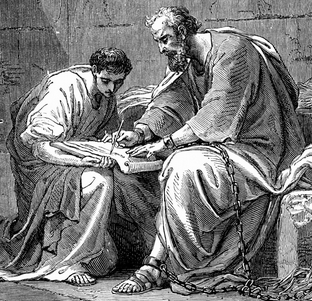
We come to the ninth pairing of sidekicks – Paul and Timothy. More is said of this relationship than any other mentor-mentee twosome in the Bible. We can capture only a small amount of this teaching in today’s devotional.
The story of Paul and Timothy begins in Acts 16 (see the verses quoted in red above). Paul was on his second missionary journey. At Lystra (northern Greece) he met the young man Timothy and took him along on the remainder of that journey, plus other travels. Timothy is mentioned 28 times in the New Testament and served at least five churches: Thessalonica, Corinth, Philippi, Berea, and Ephesus – where church tradition says he was martyred by stoning at about age 80). The New Testament contains two letters from Paul to Timothy.
Let’s consider some of the ways Paul personally viewed and challenged Timothy.
- a son: “as a son with a father he has served with me in the gospel…” (Phil. 2:22)
“Timothy, my child…” (I Tim. 1:18)
“That is why I sent you Timothy, my beloved and faithful child in the Lord, to remind you of my ways in Christ, as I teach them everywhere in every church.” (I Cor. 4:17)
- a young man with a rich heritage of faith that he had made his own – “I am reminded of your sincere faith, a faith that dwelt first in your grandmother Lois and your mother Eunice and now, I am sure, dwells in you as well…” (II Timothy 1:5)
- a gifted young man with sincere Christian character – “… train yourself for godliness… set the believers an example in speech, in conduct, in love, in faith, in purity…Do not neglect the gift you have … (I Tim. 4:7, 11)
- recognized by others and commissioned to God’s service – “…[the gift] which was given you by prophecy when the council of elders laid their hands on you “ (I Tim. 4:14)
- a teacher – “Command and teach these things…devote yourself to the public teaching of Scripture, to exhortation, to teaching…” (I Tim. 4:11, 13); “Do your best to present yourself to God as one approved…rightly handling the word of truth.” (I Tim. 2:15)
- young but approved – “Let no one despise your youth” (I Tim. 4:11)
- a source of joy for Paul – “I long to see you that I may be filled with joy.” (II Tim. 1:4)
It is no wonder, after reading all this, that Paul appreciated Timothy as one of a kind: “For I have no one like him who will be genuinely concerned for your welfare.” Others may “seek their own interests”, but not Timothy. He was a person of “proven worth” (Philippians 2:19-24).
Your Turn:
- Read II Timothy 1:1-14.
- If Paul were your mentor, what would he write about you?
- Charles Wesley wrote the great hymn “A Charge to Keep I Have” (published 1762).
1 A charge to keep I have,
A God to glorify,
A never-dying soul to save,
And fit it for the sky.
2 To serve the present age,
My calling to fulfill;
Oh, may it all my pow’rs engage
To do my Master’s will!
3 Arm me with watchful care
As in Thy sight to live,
And now Thy servant, Lord, prepare
A strict account to give!
4 Help me to watch and pray,
And still on Thee rely,
Oh, let me not my trust betray,
But press to realms on high.
These might just as well be words that Paul penned for Timothy! For example, “I charge you in the presence of God and Jesus Christ, who is to judge the living and the dead, and by His appearing and His kingdom: preach the word; be ready in season and out of season; reprove, rebuke, and exhort, with complete patience and teaching.” (II Tim. 4:1-2) Also, “The aim of our charge is love that issues from a pure heart and a good conscience and a sincere faith.” (I Tim. 1:5) Reflect on the charge God has given you – to use your gifts in His service and for the benefit of others, while exemplifying love, a pure heart, a good conscience, and a sincere faith.
DAY 234 – These are the Days of Elijah
17 And he will go on before the Lord, in the spirit and power of Elijah, to turn the hearts of the parents to their childrenand the disobedient to the wisdom of the righteous—to make ready a people prepared for the Lord.” Luke 1:17
In 1994 Northern Irish songwriter, Robin Mark, composed the song, “Days of Elijah”. It has achieved great popularity in Christian worship circles around the world. Mr. Mark explains it is a song of hope. He was watching a year-in-review news show and began to despair about the state of the world – e.g., the Rwandan war – a time of great trial but also ultimately of hope with the message of the coming return of Christ. Like so many others, I quite like the song and have been thinking of its message. In this and six following devotionals I intend to offer my reflections, while not, I hope, imposing them on the detailed explanation of the lyrics which Robin Mark himself states at https://robinmark.com/the-story-behind-days-of-elijah/. Make sure you check that out. You can hear the song as recorded by Twila Paris on YouTube at https://www.youtube.com/watch?v=Da6MoVvIqEw .
Robin Mark’s lyrics mention Elijah, Moses, John the Baptist, Ezekiel, and David. They also refer to “days of harvest” and Jesus – “Behold He comes…”. For each of these, I will discuss the servant, the times, and the call.
ELIJAH
- The Servant:
Mark’s final repetition in the song is “There is no God like Jehovah”. Correspondingly, Eli-jah’s name means God (El) is Jehovah (jah) – or Jehovah is God.
- The Times: Elijah lived in dark times. The rulers of Israel at the time were the wicked King Ahab and Queen Jezebel, who supported idolatry in the form of worship of Ba’al. Ba’al and his consort, Asherah, were understood to be the sun god and fertility god, controlling the rains, etc. At different times, these “gods” were associated with child sacrifice, prostitution, and divination. Of King Ahab we read, “Ahab did more to provoke the Lord, the God of Israel, to anger than all the kings of Israel who were before him.” (I Kings 16:32) Also, in I Kings 18 it says that Jezebel employed 450 prophets of Baal and 400 prophets of Asherah.
2. The Call: God’s call of Elijah was to confront the evil of his day, while allowing God to show His power over that evil. In I Kings 17 he is before the King and says there will be three years of famine. He flees to a secret place while King Ahab searches for him. After three years, “the word of the Lord came to Elijah”. He is called to go the King and inform him that rain is coming. (I Kings 18:1)
What happens next is the great confrontation that took place on Mount Carmel (18:20-40). He challenged these false prophets to make fire come down on an altar and when they could not do so, Elijah had lots and lots of water poured on the altar and prayed to the true God to send fire, which He did. God then sent the much-needed rain upon the land. Jezebel pursued Elijah but God protected him. Elijah was exhausted and in despair, but God reminded him that there were thousands of believers still left in Israel. He was not alone. (I Kings 18-19)
All the while Elijah was facing Ahab, Jezebel, and the false prophets, God used him to encourage and help believers. There was Obadiah, a civil servant who risked his life to protect 100 true prophets and also acted as Elijah’s point of contact with the King. There was the widow of Zarephath who in the time of famine fed Elijah her last meal and was blessed with enough food for her family for many days. Elijah was also used by God to raise the woman’s son back to life after a deadly illness. Through the miracle on Mt. Carmel, God showed the people who the true God is, turning their hearts back to Him. Then, there was the call of the next major prophet, Elisha, to whom Elijah was a teacher and example.
Your Turn:
- Read I Kings 17-19.
- We live in a time distant from Elijah’s. But it is a time not all that different from his. In our day there are some people in authority who are unworthy and in opposition to God and His followers. Furthermore, the culture is often against the truth of God. Elijah despaired – “I, even I, only am left.” (19:14) – and so might we. But God continued to give Elijah a new mission and informed him that, besides Obadiah and the woman of Zarephath, there were 7,000 others in the land who had not succumbed to Baal worship (19:18). Reflect on the state of the times and on God’s presence and provision in it.
- “These are the days of Elijah / Declaring the word of the Lord”: Regardless of the danger of Elijah’s mission, he faithfully declared the word of the Lord. That declaration led to some trouble for him, but it also blessed those people who were remaining faithful in tough times and made clear to the nation who was the true God. Our generation needs such a ministry.
DAY 235 – The Days of Moses

“By faith Moses, when he was grown up, refused to be called the son of Pharoah’s daughter, choosing rather to be mistreated with the people of God than to enjoy the fleeting pleasures of sin. He considered the reproach of Christ greater wealth than the treasures of Egypt, for he was looking for the reward…” Hebrews 11:24-26
In Robin Mark’s song, “Days of Elijah,” the second person named is Moses:
And these are the days of your servant Moses / Righteousness being restored
The Servant
Moses was born to parents of the tribe of Levi, in Egypt in approximately 1300 BC. In defiance of a royal order that Hebrew baby boys were to be killed at birth, Moses’ mother hid him for three months, then placed him in a basket which she placed in the Nile River, near where Pharoah’s daughter bathed and set Moses’ sister to watch over the boy. The princess took compassion on the child and agreed to Moses’ sister’s suggestion that a Hebrew midwife (who turned out to be Moses’ mother) be found to nurse the baby. The princess even paid wages to the mother. When the child was nursed, he was taken to the palace for an elite education. Acts 7:22 says that Moses “was instructed in all the wisdom of the Egyptians”.
As an adult, he witnessed an Egyptian beating a Hebrew and, in turn, killed and buried the Egyptian. When he was found out by Pharoah, Moses fled to the land of Midian (to the southeast from Egypt). This ended his days as a member of Egyptian upper-class society (Exodus 2:11-15) He met the daughters of a man named Reuel (also called Jethro) and married one of them, Zipporah, with whom he had a son, Gershom (Exod. 2:16-22). Then, after many years he met God at the burning bush and was called to go back to Egypt and lead his people to freedom. That led to the confrontation with Pharoah and Israel’s escape and subsequent forty years in the wilderness. Moses died as the nation was poised to enter the promised land.
The Times:
So, imagine this: Moses spent approximately 40 years within the culture of the palace and religious system in Egypt. Then he spent another 40 years leading a simple life as a shepherd in Midian. The last phase of his days was as the leader of two or three million Hebrews, wandering across the desert to the border to the Promised Land, during which time he received the Law from God and established the Hebrew worship system. Think of the immense changes in his environment and responsibilities during these three major life settings and responsibilities!
The Call:
Moses chose to identify with the God of his birth-people rather than with the worldly system of his day. He accepted the leading of God to Midian where he learned about how to live in desert-like conditions. Since his father-in-law is called “the priest of Midian” (Exod. 3:1) we can assume that Moses also learned from him. The Midianites were descended from a son of Abraham and may have incorporated much of Abraham’s faith in their practice. How much they followed Abraham’s faith, we do not know, but at least it was an environment more hospitable to Jewish beliefs than was the case in Egypt. From verses 24-29 of Hebrews 11, we could sum it up this way:
Phase 1 Called out of Egypt: “By faith Moses, when he was grown up, refused to be called the son of Pharoah’s daughter, choosing rather to be mistreated with the people of God than to enjoy the fleeting pleasures of sin. He considered the reproach of Christ greater wealth than the treasures of Egypt, for he was looking for the reward… By faith he kept the Passover and sprinkled the blood, so that the Destroyer of the first-born might not touch them.” Hebrews 11:24-26, 28
Phase 2 Called to Midian and beyond: “By faith he left Egypt, not being afraid of the anger of the king, for he endured as seeing him who is invisible.” Hebrews 11:27
Phase 3: Called to follow the Lord through the Wilderness: “By faith the people crossed the Red Sea as on dry land, but the Egyptians, when they attempted to do the same, were drowned.” Hebrews 11:29
Your Turn:
- Read Exodus 2-3.
- Robin Mark’s song speaks of “righteousness being restored” in Moses’ day. Think about what this might mean. This can be seen in the institution of the Passover (Exodus 12), when those who applied the blood of a lamb to the doorposts and lintel of their homes had their firstborn son spared from death. The Passover was a sign of what was to come when Jesus died on the cross. Accordingly, I Corinthians 5:7 calls Jesus “Christ our Passover Lamb”. John the Baptist introduced Jesus as “the Lamb of God who takes away the sin of the world” (John 1:29). I Peter 1:18-19 state that we are redeemed “with precious blood, as of a lamb unblemished and spotless, the blood of Christ.”
- Usually, our life calling comes in stages, getting clearer as we move through life. For example, with regard to a career, we might think when a young person that we’d like to be a doctor or nurse or teacher, etc. At one stage this means thinking about where we might apply for training, and later for a job, etc. Part way through a career choice we may consider a change of focus or location, and so on. Moses faced decisions at least the three phases explained above. How has God led in your life choices?
- The times in which we live may be adverse to following God. Are you willing to stand for God in the place you live and the times you live?
DAY 236 – The Days of Ezekiel
And I will put my spirit within you, and you shall live, and I will place you in your own land. Then you shall know that I am the Lord; I have spoken, and I will do it, declares the Lord. Ezekiel 37:14
These are the days of Ezekiel, / The dry bones becoming as flesh
These are the next words in Robin Mark’s song, “Days of Elijah”.
The Servant:
Ezekiel’s book is one of the books of prophecy in the Old Testament. Ezekiel was born in 622 BC in Judah. Approximately twenty-five years later the nation of Judah fell to the Babylonians and most of the promising young men were deported to Babylonia. Daniel and Ezekiel were among the exiles. Ezekiel’s group was sent to live by the River Chebar, about 100 miles south of the capital (just north of the Gulf of Persia). That is where he began his 22-year ministry.
The Times:
In 605 BC, Nebuchadnezzar of Babylon defeated the previous strongmen nations of Assyria and Egypt and went on to invade Judah. This was the fulfillment of much prophecy concerning the corruption of the nation of Judah and its consequences. Ezekiel’s message focussed on the judgment God would bring upon various nations, including Judah. But he also spoke about a time when that kingdom would be restored and be an instrument for God’s glory. At the time he spoke, things seemed very hopeless, but one day the dry bones would take on flesh and be revived, and a new temple would be built.
The Call:
God’s call on Ezekiel’s life is repeated in the early chapters:
Ezekiel 1:2-3, “the word of the Lord came to Ezekiel the priest, the son of Buzi, in the land of the Chaldeans by the Chebar canal, and the hand of the Lord was upon him there.”
Ezekiel 2:3, 7, “Son of man I send you to the people of Israel, to nations of rebels, who have revelled against Me…You will speak my words to them, whether they hear or refuse to hear…”
Ezekiel 3:4, “And He said to me, ‘Go to the house of Israel and speak with My words…’ ”
He was sent to a people with a history of refusing God’s message and messengers. He knew many would not listen, but he delivered the message of God, anyway.
Later, you can see this call, plus the nature of times and the message in chapter 37.
37:1, “The hand of the Lord was upon me…” [the call]
37:2, 3, Ezekiel is shown bones that are very dry – indicating they have been there a long time. “And He said to me, “Son of man, can these bones live? [the times – Israel & Judah had been away from God for a long time]
37:4-5, “Prophecy over these bones…Thus says the Lord God to these bones, ‘Behold I will cause breath to enter you, and you shall live.’”[the call repeated]
God later explains what the bones represent, namely, the nation of “the whole house of Israel” – both the northern kingdom of Israel and the southern kingdom of Judah (v. 11). At the time he spoke the people used to say, “Our bones are dried up, and our hope is lost; we are indeed cut off.” (37:11). But God had a message of hope for them: “And you shall know that I am the Lord…O My people. And I will put my Spirit within you, and you shall live, and I will place you in your own land. Then you shall know that I am the Lord. I have spoken and I will do it, declares the Lord.” (37:13-14)
Charles Swindoll wrote in an introduction to the Book of Ezekiel, “The book of Ezekiel reminds us to seek out the Lord in those dark times when we feel lost, to examine our own lives, and to align ourselves with the one true God. Will you consider doing so today?” [ https://www.insight.org/resources/bible/the-major-prophets/ezeki ]
Your Turn:
- Read Ezekiel 37.
- Have you experienced a long time of dark days, like dry bones? Even by Ezekiel’s day the sufferings of the nation had been with them for a long time, let alone that nation today! Do you accept God’s promise that there can better times to come, like bones becoming alive?
- Ezekiel also had a message about the need for repentance. Not all things dark are our own doing, but if choices made in your own life may have contributed to the dark times, are you willing to repent and turn to God through Christ?
- The Book of Ezekiel is enveloped at beginning and end by the amazing picture of God in His brilliance and glory in chapter 1, and Ezekiel’s message of better times coming found in chapters 40-48.
DAY 237 – The Days of David

8 “Now, therefore, thus you [Nathan] shall say to my servant David,‘Thus says the LORD of hosts, I took you from the pasture, from following the sheep, that you should be prince over my people Israel. 9 And I have been with you wherever you went and have cut off all your enemies from before you. And I will make for you a great name, like the name of the great ones of the earth. 10 And I will appoint a place for my people Israel…11Moreover, the LORD declares to you that the LORD will make you a house…16 And your house and your kingdom shall be made sure forever before me.Your throne shall be established forever.’” II Samuel 7:8-16
And these are the days of Your servant David, / Rebuilding a temple of praise. – From Robin Mark’s song, “Days of Elijah
Robin Mark’s lyrics draw our attention to the temple as an important part of King David’s days. Let’s take a look at David as a servant of God, his times, and his call.
Servant:
David was born in Bethlehem in 1040 BC (I Samuel 17:12-13). He gets attention in 28 of the 66 books of the Bible and his name is found over 1100 times. Seventeen of those times Jesus Christ is described as the “Son of David”. In Revelation 22:16, Jesus says, “I am the root and offspring of David – “root” suggests that David was descended from Jesus and “offspring” suggests that Jesus is descended from David! Jesus Himself asked the Pharisees how to explain this quandary: 35 And as Jesus taught in the temple, he said, “How can the scribes say that the Christ is the son of David? 36 David himself, in the Holy Spirit, declared,
“‘The Lord said to my Lord, “Sit at my right hand, until I put your enemies under your feet.”’
Jesus was saying that He was more than a human descendant of David (Matthew 1:1; Luke 3:23, 30). He was that, but also the Lord Creator God of David.
Times:
We can see from the calling David had as king that his were not quiet and peaceful times. He faced the Philistines, the northern tribes of Israel, the Jebusites, Edomites, Moabites, and Ammonites. Much of his story as recorded in I and II Samuel is one of conflict between him and Saul, with David and his men hiding in caves and moving constantly to avoid Saul’s pursuit. He also faced the rebellion of his son, Absalom.
Call:
In his lifetime, David was a shepherd, poet-musician, soldier, and king.
- Shepherd: I Sam. 16:11… “he is keeping the sheep”. He refers to the times he saved sheep from lions and bears (17:34-36) as evidence he was ready to face the giant Goliath. He wrote the Shepherd’s Psalm (23). God used the time as a shepherd to prepare him for bigger things to follow.
- Poet-musician: As a poet, David wrote at least 77 of the 150 psalms found in our Bible. He also was accomplished as a musician: “David took the lyre and played it with his hand. So Saul was refreshed and was well, and the harmful spirit departed from him.” (I Sam. 16:23)
- Soldier: “a man of war” (I Sam. 16:18). Not only did he defeat Goliath, but also he fought enemies from without and within until his last days, leaving his son Solomon peaceable times to build a temple and much more. When preparing to build the temple, Solomon said, “You know that David my father could not build a house for the name of the Lord his God because of the warfare with which his enemies surrounded him (I Kings 5:3).” Our song speaks to David’s role in preparing for the temple: “Rebuilding a temple of praise”. With his contribution to the Book of Psalms, David left a heritage of praise.
- King: He was king of Judah for 7 years and 33 over both Israel and Judah (II Sam. 5:3-5). Importantly, God promised him a lasting kingdom II Sam. 7:8-16. 16 ‘And your house and your kingdom shall be made sure forever before Your throne shall be established forever.
Your Turn:
- Read I Samuel 17.
- Perhaps God has called you to multiple roles, like David, with some of them being concurrent. If so, do you trust God for what it takes to fulfill His calling?
- In addition to specific roles David fulfilled, there were the temptations that find us along the way. David did not always fare well with temptations for vengeance and lust, for example (see II Sam. 21; II Sam. 11-12). His power as a warrior and as king presented opportunities that came with the job. How are you handling temptations that come your way? When you fail, are you as ready to repent as David was? (II Sam.12:13; Psalm 51)
- The power he had also gave him opportunity to help others – for example, showing kindness to Jonathan’s son, Mephibosheth (II Sam. 9). Are you using whatever ability available to you to meet needs in others?
DAY 238 – DAYS of the HARVEST

And He said to them, “The harvest is plentiful, but the laborers are few. Therefore, pray earnestly to the Lord of the harvest to send out labourers into his harvest. Luke 10:2
Our fifth devotional based on Robin Mark’s song “The Days of Elijah” is about the harvest:
These are the days of the harvest / The fields are as white as Your world,
And we are the labourers in Your vineyard / Declaring the word of the Lord!”
The words of Jesus found in Luke 10 and quoted above are also found in Matthew 9:35-36 and John 4:35-38. In the Matthew passage we find Jesus going through many villages, teaching and proclaiming “the gospel of the kingdom”, as well as showing compassion for and healing many from disease. The context of the Luke 10 passage is the Lord sending out 72 followers ahead of Him to “every town and place”. In John 4, Jesus has been speaking to the woman of Samaria about true worship and affirming to her that He Himself is the Messiah. The disciples return from town and Jesus charges them to be busy reaping the harvest of souls who are ready to receive the Christ.
Robin Mark’s song repeats what Jesus was saying, only this time applying the message to our day – it’s harvest time; fields are ready; go as a harvest labourer, “declaring the word of the Lord”.
Those of us who follow Jesus often are discouraged about the lack of interest, even active resistance, to the good news of Jesus that we see around us. But the Lord says there is a harvest waiting for labourers to reap. It is the believer’s assignment to share the gospel with any who will listen – to be a harvest worker.
There is evidence of the harvest in our world. The Gordon-Conwell Seminary report of “Status of Global Christianity” (2022) reports that Christianity is growing. See https://www.gordonconwell.edu/center-for-global-christianity/wp-content/uploads/sites/13/2022/01/Status-of-Global-Christianity-2022.pdf . At the present growth rate, the number of Christians will move from 2.56 billion in 2022 to 3.33 billion in 2050. Most of this growth will be seen in the southern hemisphere. Also climbing is the percentage of non-Christians who know a Christian – from 5.4% in 1900 to 18.3% today, and those who have not yet heard the gospel (the unevangelized) is now down to 28%, compared to 54.3% in 1900. It seems that Christians in Africa and South America are doing a better job at contributing to this growth than those of us in Europe and North America.
The numbers can be interpreted in a few different ways, and it is hard to identify who is a nominal ‘Christian’ versus who is a sincere and committed follower of Christ. Nonetheless, we are all challenged by our Lord to tell others about the salvation offered through Christ and to find ways to show compassion toward needy people around us.
We are too pray for more labourers to declare the Word of the Lord. And we are to seek harvests of people who become followers of Jesus and people who exhibit His righteousness in their daily walk.
Your Turn:
- Read Matthew 9:35-36; John 4:34-39.
- The good news is for all people, male and female, young and old. “For God so loved the world…” (John 3:16). How open and supportive are you to evangelizing children? the homeless? seniors? people of a different race/language/lifestyle than yourself?
- Jesus went to others proclaiming in word and showing compassion in deeds. Are you doing both?
 Abundant Living
