DAY 281 : The People of Philippians : PAUL (Part 1)

netage.org
21 For to me to live is Christ, and to die is gain. 22 If I am to live in_the flesh, that means fruitful labor for me. Yet which I shall choose I cannot tell. 23 I am hard pressed between the two. My desire is to depart and bewith Christ, for that is far better. 24 But to remain in the flesh is more necessary on your account. Philippians 1:21-24
Testament letter of Paul to the Philippians focuses on certain individuals: Paul himself, Jesus Christ, Timothy, Epathroditus, and two women named Euodia and Syntyche. There are lessons to be learned from all of these people. Today and tomorrow, we will consider Paul. He was a man of prayer, a thankful man, a man with a mission, a man of integrity, and a man with a future.
- A Man of Prayer, 1:3-4
3 I thank my God in all my remembrance of you, 4 always in every prayer of mine for you all making my prayer with joy.
At least twelve of the thirteen New Testament books written by Paul include a prayer (or prayers). This is one of the shortest. It is prayer of thanks and is about the people to whom Paul was writing. Whenever he prayed for them, he thanked God for them. It was a joyful experience for Paul to remember the times they had together. Are there people like that in your life? People whose remembrance brings a smile to your face and a note of gratitude in your heart? In the letter to this congregation, Paul will mention some of his memories of them.
A Thankful Man, 1:4-7 4 always in every prayer of_mine for you all making my prayer with joy, 5 because of your partnership in the gospel from the first day until 6 And I am sure of this, that he who began a good work in you will bring it to completion at the day of Jesus Christ. 7 It is right for me to feels this way about you all, because I hold you in my heart, for you are all partakers with me of grace, both in my imprisonment and in the defense and confirmation of the gospel.
Here we have some of the reasons Paul joyfully remembered them in his prayers. First, they were his partners in the work of spreading the good news about Jesus. They were with him in his primary task in life. It’s good to have people in our lives who share in what’s important to us – and who stick with us “(from the first day until now”). Secondly, he was confident that they would cooperate with God in moving forward to where God was taking them. Thirdly, he was thankful for their oneness with him in receiving and continuing in the grace of God. In particular, they were one with him in the “defense and confirmation of the gospel”. Being with him also meant identifying with him while he was a prisoner. Being in prison might be taken in society to be a shameful thing, but the Philippians were not embarrassed to stand with him and, for that, Paul was grateful.
- A Man with a Mission, 1:12-18
12 I want you to know, brothers, that what has happened to me has really_served to advance the gospel, 13 so that it has become known throughout the whole imperial guard and to all the rest that my imprisonment is for Christ. 14 And most of the brothers, having become confident in the Lord by my imprisonment, are much more bold to speak the word without fear.15 Some indeed preach Christ from envy and rivalry, but others from goodwill. 16 The latter do it out of love, knowing that I am put here for the defense of the gospel. 17 The former proclaim Christ out of selfish ambition, not sincerely but thinking to afflict me in my imprisonment. 18 What then? Only that in every way, whether in pretense or in truth, Christ is proclaimed, andin that I rejoice.
Paul was thoroughly committed to the task of taking the gospel to audiences all over the Mediterranean world. His mission was “to advance the gospel”. This ambition could even be fulfilled while in a Roman prison. Guards and fellow prisoners were his audience – one he would not have been able to reach if he were out of prison. So, while there, he continued his ministry. He hoped this testimony would encourage the Philippians, making them courageously and boldly proclaim Christ in their circumstances. He wanted them to carry on preaching Christ, not worrying about some who may have preached the right message but who did so selfishly and competitively, thinking that they were better than the imprisoned Paul. Paul was a man on a mission with a Christ-centred message. He wasn’t in competition with other missionaries and wished no ill on them (which some did for him – seeking to “afflict” Paul).
Your Turn:
- Read Philippians 1.
- How much is thanksgiving a part of your prayer life?
- Do you find that you can be a thankful person even when things are not easy for you?
- Do you often harbour jealousy or competitiveness within? Can you be grateful for someone else’s success?
DAY 282 : The People of Philippians: PAUL (Part 2)
 Paul in prison – Clip-art library
“Indeed, I count everything as loss because of the surpassing worth of knowing Christ Jesus my Lord.” Philippians 3:8
We have considered the Apostle Paul in three ways: a man of prayer, a thankful man, and a man on a mission. Next, we look at Paul as a man of integrity and a man with a future.
- A Man of Integrity, Phil. 3:1-11
In Philippians 3, Paul cautions the people in Philippi to “look out for the dogs, look out for the evildoers, look out for those who mutilate the flesh” (v. 2). He was pressing home the truth that our confidence should be in the finished work of Christ, not in any form of religious legalism. There were those in Philippi who said that Gentiles could become Christians but must also adhere to religious rites like circumcision. Religions other than Judaism practiced circumcision and other forms of cutting or mutilation, as Paul called it. In Old Testament times as in the New Testament era, the way to God was through faith, not ceremony. Here is how one source explains it, “…while the Old Testament presents circumcision as a sign of obedience and therefore evidence of trust in God’s promises (Gen. 17), it never presents circumcision as the effectual means of obtaining righteousness before the Lord. Paul picks this up in Romans 4, where he notes that Abraham was declared righteous—justified—before he was circumcised in the flesh.” [https://www.ligonier.org/learn/devotionals/place-circumcision]
Paul goes on to assert that his own salvation came not through observing zealous religious practices (he lists a half dozen examples in vv. 5-6), but through Christ: “not having a righteousness of my own that comes from the law, but that which comes through faith in Christ, the righteous from God that depends on faith” (v. 9).His life was focused on what God had done in him. Now, he wanted what was “safe” for this congregation (v. 1). He was a man of spiritual integrity.
- A Man with a Future, 3:12-20
Paul was going forward, pressing toward a “goal” and “prize” – defined in v. 14 as “the upward call of God in Christ Jesus”. He warned the readers to avoid those who were “enemies of the cross of Christ” (v. 18), whose god was their selfish desires – earthly things (v. 19). Believers already have a heavenly citizenship, where there is a Saviour waiting, the Lord Jesus Christ. One day, the Lord will “transform our lowly body to be like His glorious body” (v. 20). This future Paul speaks of, he has already identified as his deep desire in chapter 1:20-24, where he shows while he has important work to do now, on earth, he also is a man with a future:
… it is my eager expectation and hope that I will not be at all ashamed, but that with full courage now as always Christ will be honoured in my body, whether by life or by death. 21 For to me to live is Christ, and to die is gain. 22 If I am to live in the flesh, that means fruitful labor for me. Yet which I shall choose I cannot tell.23 I am hard pressed between the two. My desire is to depart and be with Christ, for that is far better. 24 But to remain in the flesh is more necessary on your account.
Your Turn:
- Read Philippians 3.
- There is a certain watchfulness that should characterize us here on earth. Many things can deter us from the path of following Christ. Are you evaluating what you here and the choices you have to make?
- There should be a balance between how we live now and what we will experience one day in glory. Think of the need for consistency or integrity in your daily walk.
- What do you value as of “surpassing worth”? (Phil. 3:8)
Day 283 – The People of Philippians: Jesus Christ

The famous statue of Christ the Redeemer on Corcovado Mtn., San Paulo, Brazil (Pinterest.com)
Christ the Redeemer (Portuguese: Cristo Redentor, standard Brazilian Portuguese: [ˈkɾistu ʁedẽˈtoʁ]) is an Art Deco statue of Jesus_in Rio de Janeiro, Brazil, created by French-Polish sculptor Paul Landowski and built by Brazilian engineer Heitor da Silva Costa, in collaboration with French engineer Albert Caquot. Romanian_sculptor Gheorghe Leonida sculpted the face. Constructed between 1922 and 1931, the statue is 30 metres (98 ft) high, excluding its 8-metre (26 ft) pedestal. The arms stretch 28 metres (92 ft) wide. It is made of reinforced concrete and soapstone. … The statue weighs 635 metric tons (625 long, 700 short tons), and is located at the peak of the 700-metre (2,300 ft) Corcovado_mountain in the Tijuca National Park overlooking the city of Rio de Janeiro. This statue is the largest Art Deco–style sculpture in the world. A symbol of Christianity around the world, the statue has also become a cultural icon of both Rio de Janeiro and Brazil and was voted one of the New 7 Wonders of the World. [Wikipedia entry: Christ the Redeemer (statue)]
——————————————————–
5 Have this mind among yourselves, which is yours in Christ Jesus, 6 who, though he was in the form of God, did not count equality with God a thing to be grasped, 7 but emptied himself, by taking the form of a servant, being born in the likeness of men. 8 And being found in human form, he humbled himself by becoming obedient to the point of death, even death on a cross. Philippians 2:5-8
The second person spoken of in the book of Philippians is Jesus Christ. If all we were aware of about Jesus is what we read in Philippians 2:1-11, what would we know?
- We would know that He is the source of oneness or unity, 2:1-2
So if there is any encouragement in Christ, any comfort from love, any–participation in the Spirit, any affection and sympathy, 2 complete my joy by being of the same mind, having the same love, being in full accord and of one mind.
Being “in Christ” brings about oneness. Paul says that when we are in Christ we receive loving comfort, the presence of the Holy Spirit, a sense of affection and sympathy (toward and from others), and complete joy. With these qualities dominating us, we find oneness, accord, and onemindedness easy to come by. Christ encourages us to get along and work with one another. This oneness is between believers who are surrendered to Christ. Later in the letter, the apostle will observe that there is some discord in the congregation and will urge that reasonableness and agreement prevail. Here in chapter 2 he is saying that such accord comes from submission to Christ.
- We would know that He is the model of humility and obedience, 2:3-8
3 Do nothing from selfish ambition or conceit, but in humility count others more significant than yourselves. 4 Let each of you look not only to his own interests, but also to the interests of others. 5 Have this mind among yourselves, which is yours in Christ Jesus, 6 who, though he was in the form of God, did not count equality with God a thing to be grasped, 7 but–emptied himself…[and] humbled Himself by becoming obedient to the point of death, even death on a cross.
Christ shows us what it takes to be part of a team of believers who are to work together in a church to get across God’s message to society. It takes setting aside personal ambition and conceit. It takes humility -defined here as considering others more important than ourselves and the interests of others ahead of our own. That is what Jesus did for us. He had the highest of positions, yet set that aside through a costly act of obedience to His Father in heaven. God the Father had sent Jesus to take our sins upon Himself and die on the cross as payment for them. The text says, “even death on a cross”. Why “even? Hebrews 12:2 speaks of the “shame” of the cross. It was shameful because He carried sin – ours – on His holy self, and because it was a form of public humiliation and torture, and a place where He was cruelly ridiculed. David Guzik, in his online “Enduring Word” commentary reflects on this phrase as follows (with quotations from Adam Clarke and Charles Spurgeon):
Even the death of the cross shows that there is no limit to what God will do to demonstrate His love and saving power to man; this was and forever will be the ultimate. “What must sin have been in the sight of God, when it required such abasement in Jesus Christ to make an atonement for it, and undo its influence and malignity!” (Clarke)
“The lower He stoops to save us, the higher we ought to lift him in our adoring reverence. Blessed be his name, he stoops, and stoops, and stoops, and, when he reaches our level, and becomes man, he still stoops, and stoops, and stoops lower and deeper yet.” (Spurgeon) https://enduringword.com/bible-commentary/philippians-2/
- We would know that He is a servant through and through, 2:6-8a
… though he was in_the form of God, did not count equality with God a thing to be grasped, 7 but–emptied himself, by taking the form of a servant, being born in the likeness of men. 8 And being found in human form, he humbled himself …
This passage shows that while Jesus is God, He willingly set that aside and became a servant . For Jesus to become a human being meant humbling Himself. Then, during His 33 years on earth, He constantly served others – washing the feet of the disciples and continuing to teach and provide for and heal people even when exhausted. Eventually, His servanthood meant dying for us on the cross. Matthew 12:18 quotes from the Book of Isaiah, saying of Jesus, “Behold, My servant…My beloved…” Jesus Himself says in Mark 10:45, “The Son of Man did not come to be served, but to serve and to give His life a ransom for many.” He models servanthood through and through.
We would know that He is elevated and honoured, 2:9-11
9 Therefore God has highly exalted him and bestowed on him the name that is above every name, 10 so that at the name of Jesus every knee should bow, in heaven_and on earth and under the earth, 11 and every tongue confess that Jesus Christ is Lord, to the glory of God the Father.
Following His death, God raised Jesus to life and “highly exalted Him” Being so honoured means that Jesus’ name is above every other, that one day everyone will bow before Him, and that Jesus is Lord. This means that the Father is glorified, too, for the Son obeyed the Father and the Father gave Jesus for us.
Your Turn:
- Read Philippians 2:1-11.
- We see much animosity in our world. How does Jesus solve the problem of hatred and conflict between people and nations?
- In whom have you observed humility in recent days? How have you been challenged to show humility in your relationships?
- What opportunities to serve someone else do you see available in your world today?
- How can you re-direct praise that someone may offer your way toward God instead?
DAY 284 – The People of Philippians: TIMOTHY

churchgists.com
But you know Timothy’s proven worth, how as a son with a father he has served with me in the gospel. Philippians 2:22
We know a lot about Timothy, the Apostle Paul’s young assistant and colleague in spreading the Gospel and discipling new believers. Paul wrote two New Testament letters to Timothy and made several references to him in other letters. Timothy had a godly mother and grandmother, came to belief in Christ on Paul’s first missionary journey, and later became pastor of the church in Ephesus. For much more on him, see https://www.gotquestions.org/life-Timothy.html .
So, what does Paul say about him in Philippians and elsewhere?
- He was genuinely concerned about the Philippian church. Paul could think of no one more concerned about their welfare (Phil. 2:20).
- He was of proven worth (Phil. 2:22). Timothy had faithfully carried out his responsibilities, for Paul and for the church.
- Timothy was like a son to Paul. He had served alongside Paul. He also had come to know Christ through Paul’s ministry (II Tim. 1:2, “my true child in the faith”).
- He was a servant of Christ Jesus (Phil. 1:1). Here is that word which Paul applied to Jesus earlier in the same chapter. Used of a person who voluntarily assumes the title “servant”, it means “one who expresses submission, recognizance or debt to another” (American Heritage Dictionary). Timothy had surrendered to the lordship of Jesus Christ over him.
- He was well-spoken of. Timothy could easily get a reference from someone if he needed one. He was help in good repute by others. See Acts 16:1-5.
- He had been imprisoned for his loyalty to Jesus. Hebrews 13:28 comments on him as a “brother” who had recently been “released”.
- He was a messenger on behalf of Paul, whom Paul would soon send to them (Phil. 1:23).
Your Turn:
- Read Philippians 2:19-24.
- Think of someone you know, a friend, a brother or sister, a pastor, etc. who is worthy of your appreciation in one or more of the ways Timothy was appreciated by Paul. Thank God for this person.
- If Paul had occasion to mention you in a letter, what would he say about you? (Don’t be too hard on yourself) .
DAY 285 – The People of Philippians: Epaphroditus, Philippians 2:25-30
 oaoa.com
So receive him in the Lord_with all joy, and honor such men … Philippians 2:29
I’m thinking of two missionary couples who have visited our church recently. They spoke about their work – supporting single young women with children, meeting other community needs, building a church – and they also emphasized how our church’s involvement (money gifts, sending teams to help with projects, praying) bound us and them together.
In Philippians 2:25-30 we see this very same thing in action in the first century. Paul and is the missionary, currently in prison in Rome, and the church in Philippi is the ‘home’ or ‘supporting’ church represented by the young messenger Epaphroditus. The Philippian church had sent Epaphroditus to Paul with news and a financial gift and now Paul was returning Epaphroditus with his thanks and a message.
The name of the person featured here today, Epaphroditus, is a male form of the name of the goddess Aphrodite, goddess of love and beauty. This tells us that he was from a family and society that worshipped heathen deities. He had come to know the Lord Jesus and was now a trusted leader of the church. There are four things to consider about this man.
- Consider Epaphroditus’ roles (Phil. 2:25)
“brother” – a close relationship to Paul had developed
“worker” – on their behalf he got to work doing jobs with Paul while in Rome
“fellow soldier” – involved in a spiritual battle
“messenger – he had taken their gifts to Paul – see the elaborate way Paul describes their gift in 4:18 (well supplied, a fragrant offering, a sacrifice pleasing to God)
“minister” – giving priestly service
- Consider his connection to the congregation in Philippi (Phil. 2:26-27a)
He had become seriously ill on this mission (“near to death”), yet his concern was that the folks back home not worry about him. He wanted them to know that he had now recovered and longed to see them again. He cared for them.
- Consider God’s care of Epaphroditus
Verse 27 shows that God had “mercy” on Epaphroditus – seeing to his recovery. God’s mercy was also to Paul who would have sorrowed all the more had his friend not recovered.
- Consider his next role
Now, Paul gave Epaphroditus a new assignment (Phil. 2:28-30). This assignment showed the bond that existed between missionary and church. Paul was sending Epaphroditus back to Philippi to relieve their anxiety for him. He wanted the congregation to honour God by receiving him joyfully. He adds that Epaphroditus was used to complete their service to Paul and should be honoured for risking his life to do so.
Your Turn:
- Read Philippians 2:25-30.
- We are to honour our missionaries, fellow-workers, and leaders. Think of some with whom you have a connection and thank God for them today. Show respect for them publicly as you have opportunity.
- Remember that your financial and other gifts do make a difference!
- Be grateful for Christian brothers and sisters.
- Visualize Epaphroditus’ return to the Philippian believers. What likely happened as they saw one another? When my wife and I return to the city where we formerly lived and worshipped, as we enter the church on a Sunday morning, we are greeted by smiles, words of joy, some hugs, and expressions of delight. Think of such times you have experienced and thank God for the ties that bind you – even now as you live at a distance.
DAY 286 – The People of Philippians: Euodia & Syntyche, Philippians 4:2-3

2 I entreat Euodia and I entreat Syntyche to agree in the Lord. 3 Yes, I ask you also, true companion, help these women, who have laboured side by side with me in the gospel together with Clement and the rest of my fellow workers, whose names are in the book of life. Philippians 4:2-3
I once had to chair a congregational meeting when the issue was whether the church should replace the pews with chairs. It was a delicate discussion. Some folk recalled seeing their daughter walk down the isle on her wedding day – made all the more lovely by the pews and a centre isle. Others promoted the idea of flexible arrangements made possible by chairs. I remember feeling tension and wished an elder other than me was handling the discussion! Eventually, when the matter was sufficiently talked out, we voted.
There are many reasons why church people might disagree: difference of interpretation in a theological dispute; how to spend the money required for renovation, equipment, repairs, missions, etc.; preferences in styles of music to be used in worship; leadership strategies and personalities; personal conflicts that lead to others taking sides; control issues; etc.; etc.
The letter to the Philippians was no doubt read aloud as soon as the church received it. Imagine the response when the reader arrived at 4:2, “I entreat Euodia and I entreat Syntyche to agree in the Lord!” Two women are named and the issue is made public – but no doubt was already well known.
So, we have here a passage about getting along in the church. We also have a case when individual differences were impacting the congregation as a whole. Paul wants the two ladies to settle matters. How could they do that?
- The offenders need to meet. Verse 2 says they should agree. This would require meeting and talking things out. The problem should not be ignored, and these women were too valuable to sit on the sidelines quarreling. Note how Paul describes them: “these women who have laboured side by side with me in the gospel, together with Clement [a church leader in Rome] and the rest of my fellow workers, whose names are in the book of life [Rev. 20:15].” They were recognized fellow believers who had gotten along with Paul, Clement, and others and needed ”to agree in the Lord” now.
- A conciliator should be present to help. “I ask you also, true companion …” writes Paul. Who was this “true companion”? We don’t know for certain. Maybe, it was Epaphroditus whom Paul was sending to them. Or perhaps Timothy. Or Luke, Paul’s companion on most missionary journeys. Or Lydia, the first convert of Philippi. Whomever the person, it was someone who could be trusted to handle a delicate and important matter.
- Reasonableness must prevail. “Let your reasonableness be known to everyone.” (v. 5) Perhaps this was an issue that could be settled by compromise, or give-and-take. If the contention is over doctrine, the church must understand what is essential and what allows for some difference of opinion. John Piper has written this [https://www.desiringgod.org/interviews/are-all-biblical-doctrines-equally-essential “The deity of Christ, the centrality of the cross, the necessity of faith, the necessity of a transformed life by the power of the Holy Spirit, and the sovereignty of God over all things—these things are right at the center. Whereas the nature of spiritual gifts, the timing of certain eschatological matters, and the mode and timing of baptism I am going to put further to the edges.” The areas Dr. Piper pus on the edge may not be the ones you would choose as ‘nonessential’, but I think you get the idea.
- Hold to prayer and positive attitudes. We see this in v. 6, “Do not be anxious about anything, but in everything by prayer and supplication with thanksgiving let your requests be made known to God.” The situation can be worked out. “Pray with thanksgiving” – including for each other, he might have added! The positive attitudes are listed in v. 8, “Whatever is true, whatever is honourable, whatever is just, whatever is pure, whatever is lovely, whatever is commendable, if there is any excellence, if there is anything worthy of praise, think about these things.” If Euodia and Syntyche were thinking in these ways, they would have little difficulty coming to agreement “in the Lord”!
- Lastly, Seek God’s peace. 7:“And the peace of_God, which surpasses all understanding, will guard your hearts and your_minds in Christ Jesus.”
Your Turn:
- Read Philippians 4.
- Is there a problem between you and someone else in your church? Have you approached him or her to discuss the matter? Is there a conciliator whom you think could help?
- Despite your differences, can you appreciate the other person as a “fellow worker” with whom you would value working side by side?
- What are the essentials in your relationship with your fellow believers and what differences can be reasonably be tolerated?
DAY 287 – The People of Philippians: The Congregation

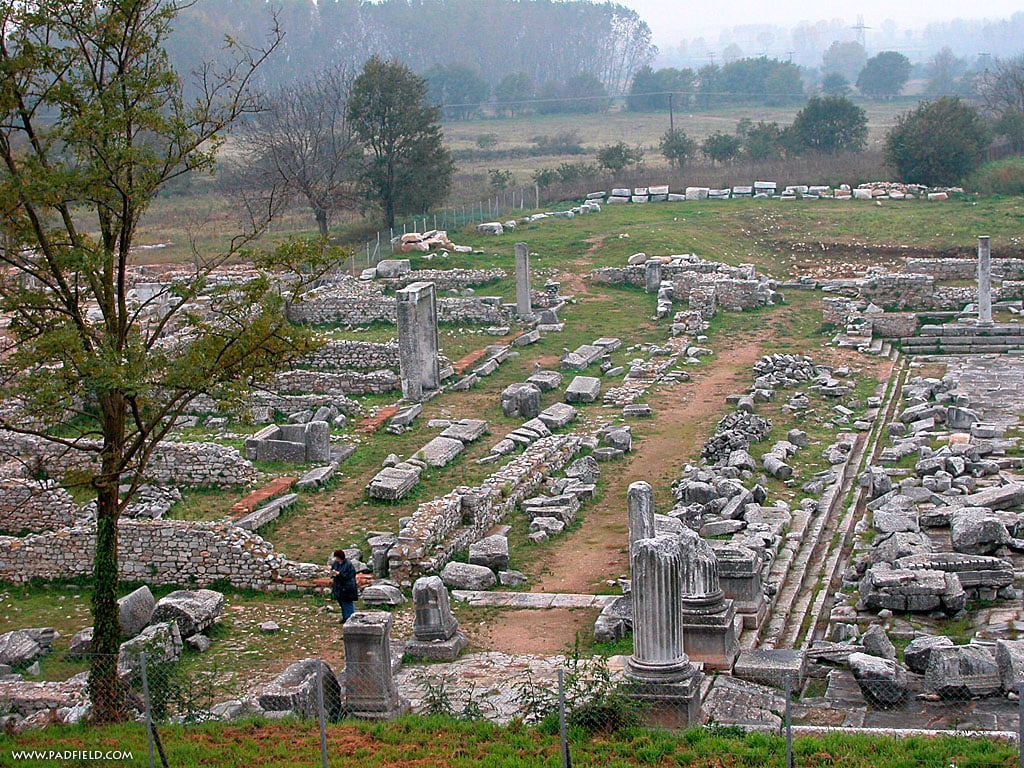
Ancient Philippi : https://greekreporter.com/wp-content/uploads/2016/07/PHIL.jpg
So, if there is any encouragement in Christ, any comfort from love, any_participation in the Spirit, any affection and sympathy, 2 complete my joy by being of the same mind, having the same love, being in full accord and of_one mind. Philippians 4:1-2
We come to the last in this series on the people of Philippians. We have meditated on Paul (2 devotionals), Jesus Christ, Timothy, Epaphroditus, and Euodia & Syntyche. To finish up, let’s look at the congregation as a whole.
What do we know about these people?
a. They had believed. Their salvation is mentioned in 1:28 and their belief in 1:29.
b. They had suffered for Christ’s sake (1:29). They were in the same conflict that Paul was in and, like Paul, has suffered. “Conflict” comes from a Greek word that also means “agony”. It had been “granted” to them to suffer – it sounds like it was a privilege! Only the strong in faith can endure suffering, so it was a compliment to say they were “granted” suffering.
c. They had obeyed Paul (2:12). The apostle was their spiritual father, the one who had delivered the good news about Jesus (Acts 16:11-34) and had mentored them, even as he was doing in this letter.
d. They had carried much concern for Paul (4:10). They had contributed to his financial needs as he moved on to other towns, sending a gift by Epaphroditus (4:15-17) who had been their “messenger and minister to my [Paul’s] need” (Philippians 2:26).
e. They had pleased God (4:18). Their sacrificial giving was like a “fragrant offering… acceptable and pleasing to God”.
These are beautiful accolades!
What did God still require of them?
a. God required that they be “worthy” of the gospel of Christ (1:27). A large part of being worthy was that they display oneness (more on that next). Another was that they be strong in the face of adversity. They were not to be afraid of those who were ‘enemies’? If we fear those against us, that gives them hope – even though their destruction by God is assured (1:27-28). They were to put others first – not looking only to their own interests but also to the interests of others – no conceit, only humility (2:3-4). They were to trust God for all their needs (4:19).
b. God required oneness (1:27; 2:2). There is a lot said in this epistle about oneness. Note the two lists on the subject of unity:
1:27 – firm in one spirit, striving with one mind, side-by-side for the faith of the gospel
2:2 – being of the same mind, having the same love, being in full accord, of one mind (again)
To achieve this oneness, it was necessary that they be people of encouragement, possess a comforting love for one another, participate in obedience to the Spirit, and hold a sincere affection and sympathy for each other (4:1-2).
c. God required that they complete Paul’s joy (4:2). The way to do that was to adhere to the four qualities just mentioned: encouragement, love, obedience, and affection.
d. God required that they complete their salvation (2:12). It seems a little odd to read about “working out salvation”. Salvation is ours by faith in the finished work of Christ, not at all dependent on our own good works. But there is still a responsibility once saved to mature in our faith by obedience to God and to show the sincerity of our profession of faith. We are to ask, seek, find, pray unceasingly, obey, and bring to fruition the work God has begun in us.
Your Turn:
- Read Philippians 1:27-30; 2:14, 12; 4:1-2, 10-21.
- The church in Philippi had been doing a lot of good things. How would your church rate on the same five points covered under the question, “What do we know about these people” ?
- As an individual, are you meeting the need for “worthiness”? How are you contributing to oneness in your church? Are you contributing to someone else’s joy? In what ways are you growing spiritually?
 Abundant Living