Day 302 – Women of the Old Testament: Victimized Women
ar.inspiredpencil.com
26 Then Judah identified them and said, “She is more righteous than I …” Genesis 38:26
Deborah Meroff was a missionary journalist for thirty years and traveled to 115 countries, mostly serving with OM International. She is the author of the book, True Grit: Women Taking on the World for God’s Sake (London: Authentic, 2006). [Available through Amazon Kindle and free at https://archive.org/details/truegrit0000debo/page/n3/mode/2up ]
In this book, we learn the following:
- 1600 women die each day from childbirth
- 50 million women survive but suffer complications
- In Napal women have a literacy rate of only 39%
- 1/3 of Napalese girls under 16 are married
- 200,000 Napalese girls and women have been kidnapped or sold into India’s brothels
- 14,000 – 20,000 small girls in Morocco have been sent as domestic servants in Casablanca
- ¼ to ½ women have been abused by a partner
- Only 44 countries specifically protect women from such abuse
- Abuse in Japan is considered a normal part of marriage with 1 out of 20 women subjected to life-threatening violence and 30% of murders being wives killed by husbands
- In Pakistan, victims of rape must show evidence of violence on their bodies plus have 4 Muslim men as witnesses
- 2/3 of the world’s illiterates are women In Yemen the illiteracy rate for women is 92%
- Most of the 2 million babies aborted in India each year are female
- Female infanticide is a huge problem in China with 116 males born compared to every 100 females
- Other problems reported in the book include female circumcision, low female life expectancy, honour killings, employment inequalities, child marriage, bride burnings, prostitution, poverty (70% are women), religious slaves, & trafficking.
What follows is a summary of Old Testament 12 women (or groups of women) who were victimized in one way or another. Consider each case, noting the nature of the injustice and the kinds of protections or remedies God provided.
Case 1: Dinah and the women of Shechem – Genesis 34; see also Deuteronomy 21:10-17 and 22:13-30.
- Rape, enslavement
- Revenge of Simeon and Levi
Case 2: Tamar (daughter-in-law of Judah) – Genesis 38; Matthew 1:3; see also Deuteronomy 25:5-10.
- Levirate marriage denied her; adultery committed with her; God executed the guilty man
- Tamar later included in Messiah’s line
Case 3: Hebrew women who gave birth to male children – Exodus 1:15-22
- Threat to kill male children
- Midwives protected mother & child and were rewarded by God
Case 4: daughters of Zelopehad – Joshua 17:1-6; Numbers 27:1-11
- Denied their inheritance
- Problem was corrected
Case 5: the Levite’s concubine; the women of Shiloh – Judges 19-21 (especially, chapter 19:22-chapter 20:7, 12-14, 46-47; chapter 21:6-12, 14, 16-21
- Concubine was raped and killed
- Shiloh women were kidnapped and entered forced marriages
Case 6: Lot’s daughters – Genesis 19:1-11
- Lot made horrible offer of his daughters to a cruel mob
- Angelic visitors protected Lot and his household
Case 7: Abigail – I Samuel 25: 2-42
- Endured a worthless and cruel husband
- She showed wisdom; her husband died; she married David
Case 8: Bathsheba – II Samuel 11:1-27 and 12:15, 24
- Forced adultery; was made a widow; her child died
- Married David and became the mother of Solomon and ancestor of Christ
Case 9: Tamar (Absalom’s sister)– II Samuel 13
- Raped by her brother, Amnon
- Amnon killed by Absalom
Case 10: David’s 10 concubines – II Samuel 15;13-16 and 16:20-22 and 20:3
- Raped by Absalom
- Rescued and provided for by David
Case 11: Israelite girl captured by Syria – II Kings Israel’s laws re. enslaved women in 21:10-14
- Trafficked and ended up a slave in Namaan’s house
- Used by God to save Namaan
Case 12: the Shunammite woman – II Kings 8:1-6; see also Deuteronomy 14:2; 24:17, 19; 27:19.
- Property was lost while away
- Property was restored
Your Turn:
- Read the above scriptures.
- Note these general lessons observed in the cases above:
- Most injustices were sexual in nature and involved family members
- The second most common injustice is enslavement.
- Other injustices involved the children of women mentioned, marriage offenses, economic rights denied
- Note also the kinds of protections or remedies God provided:
- Levirate marriage: if a man died without children, his unmarried brother was expected to marry the widow to provide an heir for his deceased brother, Deut. 25:5-6
- God’s grace in including a harmed woman in the genealogy of Christ
- Protection from the offender and/or retribution against the offender
- A special ministry given to an unlikely candidate (Namaan’s slave girl)
- The woman used to preserve a tribe of Israel
- Intervention of the powerful on their behalf
- Various laws to protect women and to emphasize that they were owed justice in the legal system
- Any others? …………..
4. For some of these victimized women there was no immediate rescue and no immediate judgement on their abusers. For them, we turn to the teaching that eternal justice will be issued by God. Ecclesiastes 12:14, “For God will bring every deed into judgment, with every secret thing, whether good or evil.”
DAY 303 – Women of the Old Testament: Miriam and Zipporah
inspirationalchristians.org
Then Miriam the prophetess, the sister of Aaron, took a tambourine in her hand, and all the women went out after her with tambourines and dancing. And Miriam sang to them: “Sing to the Lord, for he has triumphed gloriously; the horse and his rider he has thrown into the sea.” Exodus 15:20-21
Miriam – Rescuing her brother
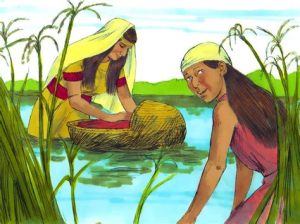
Years ago, either before I was born or while I as very young, my brother, my sister, and a friend were playing outdoors when my brother fell into an open well. He was hanging on to something and no doubt yelling for help. My sister and her friend grabbed him by the arms and pulled him out to safety. In the Bible there is a similar story of a sister saving her younger brother. It is the first of several times Miriam is mentioned in the Bible – Exodus 2:4-8. In Miriam’s case she had been told by her mother to watch over the baby Moses whom she had placed in a basket in the Nile River. Pharoah had previously ordered that all male Hebrew children be executed. Miriam watched as Pharoah’s daughter came to the river to bathe. The princess noticed the baby boy in the basket and felt pity for the child. Miriam came forward and asked if she would like a Hebrew woman to nurse the child. Of course, the woman was Moses’ mother! The princess paid Moses’ mother to care for the child until he was old enough to move into the Pharoah’s palace.
Miriam – the Prophetess Moses, Aaron, and Miriam were three famous children of Amram and Jochebed (who are commended in Hebrews 11:23 for their faith). Miriam is one of only a few women in the Bible who is called a “prophetess”. In Micah 6:4, God says to the nation that He sent Moses, Aaron, and Miriam to bring them out of slavery in Egypt. In Exodus 15:20-21, after crossing the Red Sea, we read this:
20 Then Miriam the prophetess, the sister of Aaron, took a tambourine in her hand, and all the women went out after her with tambourines and dancing. 21 And Miriam sang to them: “Sing to the Lord, for he has triumphed gloriously; the horse and his rider he has thrown into the sea.”
Miriam -the Critic Numbers 12:1-16 shows Miriam in her least honourable moment. She and Aaron publicly criticize Moses for marrying a Cushite woman. “Cushite” could refer to the people of Ethiopia, or to one of several Arab tribes, including the Midianites. Years earlier, when Moses fled Egypt, he met the three daughters of the priest of Midian. They showed hospitality to Moses who then settled in for 40 years and during that time married one of the daughters, Zipporah (Exodus 3:21-22). So, the criticism made against Moses could refer to Zipporah, or, possibly to a second wife he married later.
Regardless, the spoken criticism was not the real problem. In Numbers 12:2 we see the deeper problem: they were jealous of Moses’ authority: “Has the Lord indeed spoken only through Moses? Has He not spoken through us as well?” God summons Aaron and Miriam and strictly cautions them about questioning Moses’ role:
6 And He said, “Hear my words: If there is a prophet among you, I the Lord make myself known to him in a vision; I speak with him in a dream. 7 Not so with my servant Moses. He is faithful in all my house. 8 With him I speak mouth to mouth, clearly, and not in riddles, and he beholds the form of the Lord. Why then were you not afraid to speak against my servant Moses?”
Then, God strikes Miriam with leprosy. Perhaps she led this revolt for Aaron was not similarly punished and the feminine verb is used in describing their action. Aaron does plead for her recovery, confessing his sin as well as hers (“we have done foolishly and sinned”, Exodus 12:11) Miriam serves a seven-day sentence outside the camp and is healed before the people are allowed to move on (Exodus 12:15-16).
Miriam died at Kadesh and was buried there (Numbers 20:1). In Micah 6:4 she is honoured as a leader beside her brothers (“For I brought you up from the land of Egypt and redeemed you from the house of slavery, and I sent before you Moses, Aaron, and Miriam.”)
In this incident, there are several lessons to learn:
- Respect of God’s chosen leaders is expected of us. God will rebuke and discipline His people when they fail Him. c. God is merciful and restores Miriam. d. There is a place for intercession on behalf of others. Both Aaron and Moses pray for their sister. e. One person’s sin affects others. The people could not move on until this was resolved. f. Even the great examples of faith are prone to fall.
Zipporah
I offer only a brief note on Moses’ wife Zipporah. Already, I have mentioned the criticism Moses received for marrying a non-Jew. Zipporah had to live with such lack of acceptance by her in-laws. But God did not approve of that attitude.
She was the daughter of Jethro. She and Moses had two sons. They went with him when he returned to Egypt to face Pharoah. Along the way Moses was threatened with death for his lack of obedience to the command found in Genesis 17:9-14, namely, that every male child be circumcised (“… 10 This is my covenant, which you shall keep, between me and you and your offspring after you: Every male among you shall be circumcised. 11 You shall be circumcised in the flesh of your foreskins, and it shall be a sign of the covenant between me and you.”) Zipporah intervenes and circumcises her sons, thus sparing her husband and sons (Exodus 4:24-26). At some point, she and the boys returned to her father until Moses and the people were freed from Egypt, when they were reunited (Exodus 18:1-9).
Your Turn:
- Read Exodus 2:4-8; 4:24-26; 15:20-21; 12:1-16; 17:9-14; 18:1-9. Notice that Moses had to be twice rescued by women – once by his sister and once by his wife. 3. Give some thought to the heavy role women carry in leadership (like Miriam) and as a support for her husband and children (Zipporah). 4. Are you praying for the women in your life?
DAY 304 – Women of the Old Testament: Rahab
tandrewsstockton.org
By faith Rahab the prostitute did not perish with those who were disobedient, because she had given a friendly welcome to the spies. Hebrews 11:31
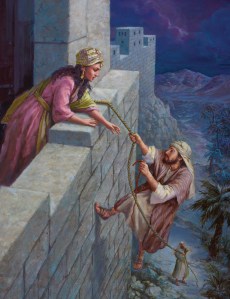
Rahab’s story is told in Joshua 2 and 6, with additional mention in three New Testament books: Matthew 1, Hebrews 11, and James 2. In all cases she is commended.
Her Past
Except for Matthew, Rahab is always introduced as “Rahab the prostitute”. That is how she was known before her supreme act of faith. There was a great change in Rahab. This is explained in the helpful commentary on Rahab found in the web site, “Got Questions” [ https://www.gotquestions.org/life-Rahab.html ]
Spiritually, Rahab was not in an ideal circumstance to come to faith in the one true God, the God of Israel. She was a citizen of a wicked city that was under God’s condemnation. Rahab was part of a corrupt, depraved, pagan culture. She had not benefited from the godly leadership of Moses or Joshua. However, Rahab had one asset—she had heard from the many men she came into contact with that the Israelites were to be feared. She heard the stories of their escape from Egypt, the crossing of the Red Sea, the wanderings in the wilderness, and their recent victory over the Amorites. She learned enough to reach the correct, saving conclusion: “For the Lord your God is God in heaven above and on the earth below” (Joshua 2:11). It is this change of heart, this faith—coupled with the actions prompted by faith—that saved her and her family… [O]nce we come to Christ, our pasts no longer matter. The slate is wiped clean for all who believe and accept the sacrifice of Jesus on the cross on our behalf. …Just as she was grafted into the line of Christ, so we become children of God and partakers in His inheritance (Romans 11). …In her story, we learn of the amazing grace of God that can save even the worst of sinners and bring them into an abundant life in Christ Jesus.
Her Present
For her, the “present” was the time God was about to bring His people into the promised land under Joshua’s leadership. Her present is known for belief and faith, for the deeds that came from that faith, and for concern for her family.
And [she] said to the men, “I know that the Lord has given you the land, and that the fear of you has fallen upon us, and that all the inhabitants of the land melt away before you.” Joshua 2:9
“… for the Lord your God, he is God in the heavens above and on the earth beneath.” Joshua 2:11
By faith Rahab the prostitute did not perish with those who were disobedient, because she had given a friendly welcome to the spies. Hebrews 11:31
And in the same way was not also Rahab the prostitute justified by works when she received the messengers and sent them out by another way?
James 2:25, And in the same way was not also Rahab the prostitute justified by works when she received the messengers and sent them out by another way? – Her “works” were the actions prompted by faith as stated in the “GotQuestions” except above.
Her Future
What awaited her was rescue and a new life with God’s people (Joshua 6:22-25):
… So the young men who had been spies went in and brought out Rahab and her father and mother and brothers and all who belonged to her. And they brought all her relatives and put them outside the camp of Israel. And they burned the city with fire, and everything in it … But Rahab the prostitute and her father’s household and all who belonged to her, Joshua saved alive. And she has lived in Israel to this day, because she hid the messengers whom Joshua sent to spy out Jericho.
Also, she joined those who by faith receive the lasting life promised by the Lord – Hebrews 11:13-16)
13 These all died in faith, not having received the things promised, but having seen them and greeted them from afar, …14 For people who speak thus make it clear that they are seeking a homeland. … 16 But as it is, they desire a better country, that is, a heavenly one. Therefore, God is not ashamed to be called their God, for he has prepared for them a city.
Your Turn:
- Read Joshua 2:1-24; 6:22-25.
- When the King of Jericho heard that two Israeli spies had come to his city, he sent soldiers to Rahab’s house. She said, ‘Yes, they were here but they left’ and hid the men until darkness allowed them to escape. She lied to the soldiers. Do you have a problem with that? Are there times when someone who has evil intentions is not deserving of the truth? Could God have protected the spies another way? For some thoughts on this issue, see The Apologetics Press at https://apologeticspress.org/did-god-approve-of-rahabs-lie-5437/ .
- On what did Rahab base her faith? How much information did she have in order to make her choice to follow Israel’s God?
Day 305 – Women of the Old Testament: Deborah
 animalia-life.club
4 Now Deborah, a prophetess, the wife of Lappidoth, was judging Israel at that time. 5 She used to sit under the palm of Deborah between Ramah and Bethel in the hill country of Ephraim, and the people of Israel came up to her for judgment. 6 She sent and summoned Barak the son of Abinoam from Kedesh-naphtali and said to him, “Has not the Lord, the God of Israel, commanded you … Judges 4:1-6a
What is the background to Deborah’s story?
The people did evil in the Lord’s sight (Judges 4:1). This was after the death of Ehud, who had led Israel to victory over the Moabites and achieved eighty years of peace. Ehud had trusted the Lord to deliver his people from the enemy, but when he died the people reverted to false worship and other evils, resulting in twenty years of subjection to King Jabin and his military leader, Sisera. Sisera had a formidable army and 900 chariots of iron (4:3). That leads us to Deborah.
Who was Deborah?
- She was a prophetess – one of five women named to that position in the Old Testament. (The others were Miriam – Exod. 15:20; Huldah – II Kings 22:14 & II Chronicles 34:22-28; Isaiah’s wife -Isaiah 8:1-4; and a false prophetess, Noadiah (Nehemiah 6:14). Prophets and prophetess’ were God’s spokespersons.
- She was a wife – “the wife of Lappidoth”, Judges 4:4. Deborah had personal responsibilities as well as public ones. In their marriage, it was the woman who gained the attention of the public and is described as a spiritual and political leader.
- She was a judge – “was judging Israel at that time” (4:4). She is one of twelve judges mentioned in the Book of Judges. We see one part of her job in verse 5. People came to her for judgment, and no doubt she assessed disputes and offered a ruling one way or another. But judges were also military leaders and we see Deborah gathering an army of 10,000 men under the command of Barak (4:6) in order to challenge Jabin’s army and free Israel from oppression. Other judges did the same – Gideon, Samson, etc. She gave Barak instructions, accompanied him to battle, told him that now was the time to act for God was going before them (4:14), and forecast that the glory Barak could have gained from this battle would instead go to a woman (4:7-9). That woman turned out to be Jael who killed Sisera (4:17-22).
- She was a poet and song-writer (chapter 5). The song includes the following:
- Gratitude to the people for following their leaders
- Praise to God for His control of the situation
- Singled out honour to Jael
- Heartfelt gratitude to Israel’s commanders and tribes of Israel who responded to the call to arms and rebuke to those who did not
- Mention of the musicians and others who would sing God’s praises
- Mention of Barak’s leadership
- Description of the forces of nature that worked against Sisera’s army
- A final word of praise to God in 5:31, “So may all your enemies perish, O Lord! But your friends be like the sun as he rises in his might.”
- Through her, God gave the land 40 years of peace (5:31b)
Your Turn:
- Read Judges 4 and 5.
- Can you think of some women who have provided faithful and beneficial leadership to society, to your church, etc.? Often it is the women who prove more faithful than the men in our churches.
- Deborah is mentioned in only a positive way, unlike some other famous judges in this era between Joshua and Samuel.
DAY 306 – Women of the Old Testament: Ruth, Naomi & Orpah
messianic-revolution.com
For where you go I will go, and where you lodge I will lodge. Your people shall be my people, and your God my God. 17 Where you die I will die, and there will I be buried. Ruth 1:16-17
There are very few people in the Bible about whom nothing negative is said. The Lord was, of course sinless, but as for the rest of us, that is certainly not the case. Ruth is one of the few – we always see her in a positive light. After the troubles recorded in the Book of Judges, reading the Book of Ruth is like reading a ‘feel good’ story, a ‘good news story’ – a welcome change.
The meaning of the names of folk in this story are appropriate. When a famine hit the Promised Land, Eliminech (= my God is king) and his wife Naomi (= pleasant, beautiful, agreeable), and their two sons (Mahlon = sick, infirm) and Chilion (= pining, finished) moved to neighbouring Moab. The sons married foreign women contrary to the law of Moses (Deuteronomy 7:3) and after ten years, died, along with Eliminech. We now have three widows. Naomi temporarily changed her name to Mara (= bitter). It is not yet a ‘feel good’ story, is it!
The time came for Naomi to return home. Her daughters-in-law started out on the trip to Bethlehem but Naomi advised them to return to Moab. Orpah (= skull or neck) turned back, loving her people and their idols more than the people of God. II Thessalonians 3:2 says, “All people are not of faith.” Ruth ( = satisfied) preferred the people of Israel and their God, and was “saved by faith” (Ephesians 2:8). Notice that the women faced a choice: “to her people and her gods” (Ruth 1:15) vs. “To your God and my God” (1:16). Ruth’s vow has seven parts:
- “Do not urge me to leave you or return from following you” (1:16). This choice would affect the rest of her life.
- “Where you go, I will go” (1;16). It is not easy to leave what you are accustomed to. Going where God leads you can be costly emotionally.
- “Where you lodge, I will lodge (1:16). She would live with her mother-in-law. Sometimes being a follower of Jesus means developing a new affinity with God’s people, over and above previous attachments.
- “Your people shall be my people” (1:16). She was willing to break from the long-held hostility of the people of Moab and the people of Israel and identify with those considered enemies. Being a follower of Christ might mean breaking cultural ties you once had.
- “Your God my God” (1:16). This was the highest affirmation.
- “Where you die, I will die” (1:17. This was a life-long decision.
- “And there I will be buried” (11:17). This emphasizedthe lastingness of the decision.
God’s timing
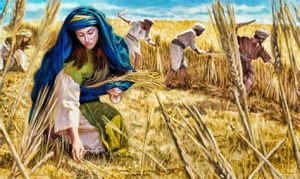
The two women returned at the most opportune time – barley harvest. It was opportune not just because it was a good time to get free food (gleaning leftover sheaths as the crop was harvested); but also because Ruth (= satisfied) would meet Boaz (= strength). It was spring, the season of the first fruits, likened to the time of resurrection for us – “ But in fact Christ has been raised from the dead, the firstfruits of those who have fallen asleep” (I Corinthians 15:20). The old life in Moab died; the new life in Bethlehem began.
Evidences of God’s providence in Ruth’s life:
She marries into an Israelite family and learns about God (1:4).
She is granted her wish to go with Naomi (1:18).
She arrives in the time of barley harvest (2:3).
She is directed to Boaz’ field (2:1).
She is treated generously by Boaz (2:8-10).
She has a good teacher in Naomi, who knows the Mosaic Law (3:6-13).
She is loved by Boaz (2:13-19, etc.).
God removes the obstacle of the nearest relative (2:20; 4:1-10).
She is accepted by the Bethlehemites (4:11-12).
She is blessed with a child (4:13).
Her child becomes the grandfather of King David and an ancestor of Jesus (4:18-20).
Your Turn:
- Read Ruth chapters 1-4.
- Think of the providences of God in your life.
- Reflect on the choice all people must face: some earthly god or obsession vs the one true God.
- The choice to follow Jesus is a lifelong one. Has that been the case in your life?
- In what ways does Ruth show herself a responsible adult and a faithful follower of God? See Ruth 2:3-4, 7b, 10,11, 13, 22-23; 3:5. Also, see Lev. 23:22; Deuteronomy 24:19; 25:5, 7-10.
- The vows Ruth makes can be applied in several ways to the vows a couple make to each other at the time of their wedding. (My wife quoted Ruth 1:16-17 at our wedding.)
DAY 307 – WOMEN of the OLD TESTAMMENT: HANNAH
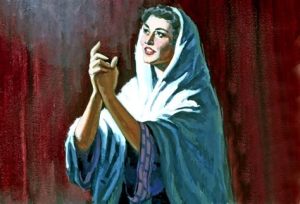
10 She was deeply distressed and prayed to the Lord and wept bitterly. 11 And she vowed a vow and said, “O Lord of hosts, if you will indeed look on the affliction of your servant and remember me and not forget your servant, but will give to your servant a son, then I will give him to the Lord all the days of his life, and no razor shall touch his head.” …27 ”For this child I prayed, and the Lord has granted me my petition that I made to him. 28 Therefore I have lent him to the Lord. As long as he lives, he is lent to the Lord.” I Samuel 25:10-11 27-28
Nearly a thousand years before Jesus was born in Bethlehem a woman named Hannah gave birth to a son she named Samuel. Hannah was married to Elkanah who loved her, but who had made the mistake of also marrying a second wife, Over several years of this double marriage, Peninnah had several children while Hannah had none. This was a great sorrow to Hannah, made worse by Peninnah’s irritation and provocation of her. And not only that, Hannah’s husband, though treating her with favour, failed to understand Hannah’s sadness. All this is learned from I Samuel 1:1-8.
Out of this difficulty, Hannah prayed to the Lord. The scripture surely shows her as a woman of prayer. We see her praying in I Samuel 1:10-11 and again in chapter 2:1-10. The first time, it is a prayer that contains her request and her promise to God (or vow).
The request: ‘Lord, remember my affliction and give me a son.’ This prayer was specific and showed confidence in God’s ability to grant such a request and belief in His compassion.
The vow: ‘I will give my son back to You, Lord, to serve You all the days of his life.’ She promises to leave the boy’s hair uncut, evidence of a Nazarite vow. [See Numbers 6 for the requirements of such a vow. The vow could be for a specified time or life long, as with Sampson, Samuel, and John the Baptist.] In due time, Hannah did have her son and once he was weaned, Hannah gave him to God with the High Priest, Eli, raising him. See I Samuel 1:21-28.
This leads us to the second prayer, recorded in chapter 2. In it, Hannah worships and exults God, providing a list of at least 15 things for which she is grateful.
1 salvation from her enemies (vv. 1-2)
2 the singular nature of God (2b)
3 God’s power (2c)
4 God’s knowledge (3a)
5 God’s justice (3b)
6 God strengthens (4)
7 God feeds the hungry (5a)
8 God enables the barren to have children (5b)
9 God can raise the dead (6)
10 God can enrich the poor (7a)
11 God exults the humble (7b)
12 God lifts the poor (8a)
13 God honours the lowly (8b)
14 God sustains the earth (8c)
15 God protects the faithful (9-10)
As a result of her believing prayer, her boy Samuel remained in the Temple “ministering to the Lord” (v. 11).
Your Turn:
- Read I Samuel 1-2.
- Of Hannah’s 15 qualities of God, what have you experienced for which you, too, can thank God?
- Of these 15, what ones do you need now in your life?
- One difficulty many face is being misunderstood by people whom we value in our life. Hannah was misunderstood by her husband (v. 8) and by Eli, the priest (v. 13). Both meant well, but they caused Hannah further grief. Who really did understand her sorrow and need?
- Notice that a person can be exemplary in her faith and still face problems in her life. Another lesson is that we must not let other people deter us from our trust in God. `
DAY 308 – David’s Wives (Abigail, Michal, Bathsheba, + at least 5 others named)
 slideserve.com
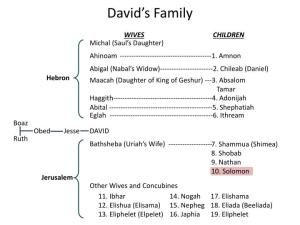
32 And David said to Abigail, “Blessed be the Lord, the God of Israel, who sent you this day to meet me! 33 Blessed be your discretion, and blessed be you, who have kept me this day from bloodguilt and from working salvation with my own hand!…39 Then David sent and spoke to Abigail, to take her as his wife.40 When the servants of David came to Abigail at Carmel, they said to her, “David has sent us to you to take you to him as his wife.” 41 And she rose and bowed with her face to the ground and said, “Behold, your handmaid is a servant to wash the feet of the servants of my lord.” 42 And Abigail hurried and rose and mounted a donkey, and her five young women attended her. She followed the messengers of David and became his wife. I Samuel 25:32-33, 39-42
David had at least eight wives. By them he had at least ten sons and one daughter. He also had a son by an unnamed mother, plus nine other sons born in Jerusalem by other women. That makes at least nineteen children. Clearly, he had problems with lust and buying into worldly values. In this ‘Short Thoughts’ we will focus on three of his wives: wives associated with politics, principle, and passion.
- The Wife of Politics: Michal
Michal was the younger daughter of King Saul (I Samuel 14:49). The older daughter, Merab, was offered to David for his success in fighting the Philistines (I Sam. 18:17-28). Saul had hoped David would be killed by the enemy, so gave Michal to another man. Michal loved David and Saul said he would approve the marriage if David slew 100 Philistines. David and his men slew 200 and the marriage went ahead.
Michal helped David escape Saul (I Sam. 19:11-17 – In v. 13, note the reference to an idol Michal owned). Then Saul gave Michal to another man and David found a way to get her back (I Sam. 25:44; II Sam. 3:12-16). She disapproved of David’s celebration dance as the ark of the covenant was brought to Jerusalem (II Sam. 6:16, 20-23).
What do we learn about Michal? – was caught up in a violent time and in a feud not of her making – her love for David made her willing to take risks to protect him – was a victim of politics – she had an idol and did not enter into celebrations of the Ark’s return – was disciplined by God
- The wife of Principle: Abigail
You can read her story in I Samuel 25. Abigail was married to a foolish husband – Nabal was rich, badly behaved, and harsh, insulting David’s men and refusing to show gratitude towards David. Abigail was the opposite and, thus, the servants knew to whom to go when a crisis developed and they needed help (I Sam. 25:14). She was able to act quickly when necessary (v. 18), and showed tact and respect toward David. She challenged David to act differently than her husband and directed him to think about what God would want (vv. 24-31). David listened to her and she saved her household (vv. 32-36). After Nabal died, she married David (v.41). Later, she was rescued by David after enemies took her and others captive (I Sam. 30:5, 18).
What do we learn about Abigail? – had impeccable character – acted decisively in a time of crisis – directed David’s heart away from revenge and instead to God – showed remarkable insight into God’s promises to David – knew God would protect David (vv. 27-31) – was herself protected by God in two life-threatening emergencies – is an illustration of the believer who is dead to sin (Nabal) and united to Christ
- The Wife of Passion: Bathsheba
See II Samuel 11 and 12. David saw Bathsheba bathing, summoned her, and committed adultery with her. When she reported that she was pregnant, David sought to cover his sin by bringing Bathsheba’s husband, the heroic soldier Uriah, home from battle. When the plan didn’t work, David arranged for Uriah to be put into the front lines where he was killed in battle. After Bathsheba mourned her husband (11:26), David then married her (11:27). Their child was born but died in infancy (12:19).
The couple had a second son, Solomon (12:24-25). Bathsheba and Solomon are mentioned in the line of Christ (Matthew 1:6-7). As David was dying, Bathsheba followed the counsel of Nathan, God’s prophet, and intervened with her husband on behalf of Solomon, who had been promised the right of succession (I Kings 1).
What do we learn about Bathsheba? – was victimized by David but rewarded by God by becoming an ancestor of Christ – experiences suffering and then comfort from her husband – listened to the prophet of God (Nathan) – as a good mother, she stood up for her son
Your Turn:
- Read about Michal in I Samuel 18,19; II Samuel 6. Also, about Abigail in I Sam. 25, 30. And about Bathsheba in II Samuel 11 and I Kings 1.
- What additional lessons can we learn from these three women?
- How have you handled a situation where you were the victim
- of office politics?
- of poor judgment or risky behaviour by a family member?
- of physical or sexual abuse?
- Have you seen God’s presence even in these difficult situations?
 Abundant Living