DAY 309 – WOMEN OF THE OLD TESTAMENT: Wicked Women – Potiphar’s Wife, Delilah, Jezebel, & Athalia
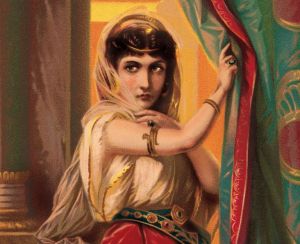
Illustration of Jezebel from christianity.about.com
And also concerning Jezebel the LORD says, ‘Dogs will devour Jezebel by the wall of Jezreel.’ (There was never a man like Ahab, who sold himself to do evil in the eyes of the LORD, urged on by Jezebel his wife…)
I Kings 21:23-25
Logos Bible Software yields this result when you search for “Women, Wicked, Instances of”:
“Eve, Sarah, Lot’s wife, Daughters of Lot, Rebekah, Rachel, Leah, Dina, Tamar, Potipher’s wife, Zipporah, Rachel, Rahab, Deliah, Peninnah, Midianite women in the camp of Israel, Michal, Bathsheba, Solomon’s wives, Jezebel, the cannibal mothers of Samaria, Athaliah, the sodomites of Judah, Noahdiah the false prophetess, Haman’s wife, Job’s wife, the idolatrous of Hosea, Herodias, the daughter of Herodias, Sapphira, and the woman caught in idolatry.”
I would not include a few of these as “Wicked”, but, in any case, the list tells us that women can be sinful as well as men!
For this “Short Thoughts” I have chosen four women to consider: Potiphar’s wife, Delilah, and Athalia.
-
Potiphar’s Wife – Genesis 39:7-20
She tried to temp Joseph into an immoral affair, then turned the account into a negative report about Joseph to her husband. What was her sin? How would you characterize it?
-
She was a source of temptation.
-
She lied about it when he refused, showing herself to be persistent and mean-spirited.
-
She kept quiet about Joseph’s innocence as he was sent to prison.
What lessons do you learn about the nature of evil?
-
It can be open and direct.
-
It can be unrelenting.
What lessons do you learn about how a righteous person should deal with the wickedness?
-
Joseph resisted, with good reasons provided (it would be a sin against her husband and God). He avoided her. He ran from the temptation. Some temptations should be avoided by separation from the source of the temptation.
-
The righteous suffer unjustly from the sin of others.
-
God can use the suffering of the righteous for good in his/her life and the life of others.
-
Delilah – Judges 16:4-20
Delilah means “dainty one”. She lived in the valley between Jerusalem and the Mediterranean. Her sins might be described as persistent deception, plotting, incremental temptation.
What do you learn about the nature of evil?
-
It will use whatever works.
-
It attacks our weakness.
-
It m us and destroy us – it makes a fool of us; it leads to loss of ministry.
What do you learn about how to deal with wickedness??
-
Stop when you sense danger. Samson obviously didn’t trust Delilah from the beginning
-
Jezebel – I Kings 18:4, 13; 19:2; 21:1-16; 21:25, 17-27; II Kings 9:30-37
Queen Jezebel tried to impose Baal worship on Israel. Her husband was Ahab, who reigned from 874-853 BC. He built a temple and altar to Baal (I Kings 16:32). His wife died 11 years after Ahab.
What were her sins?
-
Murder, threat of murder, conspiracy, making false accusations, lying, using a religious front for evil, theft, idolatry
What lessons do we learn about the nature of evil?
-
Evil is relentless, is associated with idolatry, and is an attack upon God.
What do we learn about how a righteous person should deal with wickedness?
-
Do the right thing (as Obadiah did), even when there is great risk. Remind yourself of the truth and the honourable way (as Naboth did). Meet evil head on – stand up to it (as Elijah and Jehu did).
-
This shows there are different ways to resist evil.
-
Resistance to evil may not end well in this life, but evil will be judged in the end and the righteous vindicated.
-
Athaliah – II Kings 11:11-16; II Chronicles 22:10, 12; 33:12-15
Athaliah was the only woman to reign over Judah. She was the daughter of Ahab and Jezebel and the mother of Ahaziah. She tried to murder all the royal family, but Ahaziah’s son, Joash, was helped to escape and was hidden in the Temple. Seven years later, Jehoiada the priest, devised a plot against Athaliah and crowned Joash King. Athaliah was executed.
What was Athaliah’s sin?
-
Murder, threatening
What do we learn about the nature of evil in this story?
-
Evil is ruthless, even to the extent that children are killed.
-
It is deluded – Athaliah claimed she was the victim of treason (II Kings 11:14).
What lesson do you learn about how the righteous person should deal with the wickedness?
-
God has His servants to help and assist the threatened saints. He gives us advisors as well as protectors.We need to be patient (in this case, Jehoiada waited seven years for the right time to act) as we wait for God to act to ride the evil.
Your Turn:
-
Read the Bible passages indicated for each case.
-
As you face evil, seek to identify the nature of the sin pressing against you.
-
What helpful lessons do you learn from the response of righteous people in each of these situations? What response is appropriate for you in some threat you sense against you now?
DAY 310 – Women of the Old Testament: ESTHER

And who knows but that you have come to royal position for such a time as this. Esther 4:14b
Esther’s story is told over ten chapters in the book named after her. It is the last of the historical books of the Old Testament, focusing on events during the reign of Ahasuerus (or Xerxes), 485-465 BC.
Chapter 1: When Queen Vashti refused to go on display, he interviewed others for that position. Whoever was chosen would be entering into a marriage to an angry man who had absolute power as King.
Chapter 2: We are introduced to Mordecai, a Jew who had been deported from Judah during Nebuchadnezzar’s time. Esther was Mordecai’s much younger cousin and Mordecai attentively acted as her father. Esther was one of those considered to become the new queen. She won the favour of Hegai, chief of the harem.
Thus far, we learn that Esther knew loss (her parents had died; she was a captive in a foreign land), knew danger and stress (a member of a harem of a heathen king), knew love and care (from Mordecai), knew God’s provision and protection (from Hegai), and had received good instruction (from Mordecai and Hegai). When the king chose her as the new queen, we see how God placed her in a place of influence, preparing her for later action.
Chapter 3: Haman arranged the get the King’s permission to kill as many Jews as he could and plunder their possessions.
Chapter 4: Mordecai learned of the plot against the Jews. He and many others mourned. He asked Esther to go into the King and plead for her people. No doubt it was difficult for him to ask, seeing it could be dangerous (4:16, “if I perish, I perish”). Mordecai’s part was to gather others to pray and Esher’s part was to approach the King.
Chapter 5: God used Esther’s faith and her intelligence. She was not just a pretty face! She derived a plan.
Chapter 6: God’s providence is seen in this chapter. The King cannot sleep so asked for court records to be brought. In this way he learns of Mordecai’s previous patriotism. He asks Haman what should be done for the man the King wishes to honour. This leads to Haman’s humiliation.
Chapter 7: Esther reveals to the King the plot of Haman. The King’s anger is turned on Haman who is hanged on the gallows he had prepared for Mordecai.
Chapter 8: Esther is given Haman’s estates which she then gives to Mordecai. She risks going into the King’s ruling chamber and asks the King for a proclamation which allows the Jews to protect themselves. God gives her the King’s blessing. Mordecai is put into a place of power, the Jews are victorious, and the Persians fear them instead of the other way around.
Chapter 9: The success of the Jews is recorded here. These days become an annual celebration.
Chapter 10: The greatness of Mordecai is reported as he becomes (like Daniel earlier) second in the kingdom.
Your Turn:
-
Read the Book of Esther.
-
Think about the times in which you live – times of recession and times of expansion; times of peace and times of war; time of social upheaval, technical advances, medical progress, etc. We do not pick the times, nor the colour of our skin, etc. Mordecai realized Esther was made for “such a time as this” (4:14). So, too, God has placed us in a time and a place where we can be used for His glory.
-
Note Mordecai’s trust in God to deliver His people one way or another (4:14, “relief and deliverance for the Jews will arise”). Later, God explained to the prophet Ezekiel that He chooses from among His followers a man or woman who will come forward to help when help is needed (Ezekiel 33:1-9). We need to be available and ready to act.
-
Jews remember Esther and her story annually in the celebration called “Purim”. In 2025 this event was held on March 13-14. Purim means “lots” and refers to the time when the wicked Haman drew lots to determine the days his forces would kill the Jews (Esther 3:7). Read about how the holiday that recalls Esther’s story is celebrated today at https://www.ifcj.org/learn/jewish-holidays/what-is-purim .
DAY 311 – JOHN 8: JUDGMENT
15 You judge according to the flesh; I judge no one.16 Yet even if I do judge, my judgment is true, for it is not I alone who judge, but I and the Father who sent me. John 8:15-16
If I were to pick one word to convey the teaching of Jesus in John chapter 8, it would be “judgment”. Judgment might refer to a decision in a court of justice, the sentence handed out after a ‘guilty’ judgment, the person who can make or pass judgment, etc. In John 8 the term is used six times, and other terms carrying the same sense (e.g., law, charge, condemn, witness, truth, convicts) are also found. There are four ways in which judgment is discussed in this chapter.
-
Verses 1-12 – the woman caught in adultery
The scribes and Pharisees brought to Jesus a woman whom they said had been caught in adultery. Presumably, the man had escaped, or it was a set-up! They reminded Jesus of the law of Moses (Lev. 20:10; Deut. 22:22-24 – death for both parties, in some cases, by stoning) and asked what He thought should be done. If He said, ‘Stone her’, He would be in trouble with the Roman authorities. If He said, ‘Spare her’, they could assert that He disregarded scripture. It was a “test” (v. 6). Jesus stooped and wrote something in the ground (we do not know what), then said, “Let him who is without sin be the first to throw a stone at her.” (v. 7) None was willing to do that, so all went away. Once alone with the woman, Jesus pointed out that no one had condemned her. He concluded, “Neither do I condemn you; go, and from now on sin no more.” (v. 11) With no witnesses left to accuse her; and without witnessing the event Himself, Jesus gave mercy and urged a change of lifestyle. The story also raises the question of who is in a position to judge another. He is the only one there who is “without sin”.
-
Verses 12-30 – the Light of the world
The Pharisees question Jesus’ right to bear testimony about Himself (v. 13). Jesus refuses their assertion because of where He has come from (v. 14) – He is the God of heaven. He adds that He is not alone in His claim to be the Light of the world: “… it is not I alone who judge, but I and the Father who sent Me … In your law it is written that the testimony of two people is true. I am the one who bears witness about myself, and the Father who sent Me bears witness about Me” (v. 16). The Lord says more about being from another world (vv. 21-23a). He invites them to believe in Him; if they don’t, they will die in their sins, but many do appear to believe (vv. 23b-30). He will pay the price (judgment) of their sins by being “lifted up” (on the cross). The Light had come to show them to way to heaven and the Father.
-
Verses 31-47) – the truth sets us free
Truth is key in a courtroom: the truth, the whole truth. So, in a discourse about judgment, it is important to establish how to recognize truth. Those who had indicated belief in Him are now given direction about how to find truth. “If you abide in My word, you are truly My disciples, and you will know the truth and the truth will set you free.” (v. 31) Perhaps these people are not yet well grounded in the faith, or perhaps their profession was not real. He warns them about the devil (v. 44), the father of lies. In contrast is Jesus, who came from God the Father and speaks words of truth. He cannot be convicted of sin (v. 46a). If these folk are truly believing in Him, they will listen to what Jesus tells them (vv. 46b-47).
-
Verses 48-59 – God is the judge
Some listeners suggest that Jesus has a demon. Jesus refutes that charge. It is God the Father who is the true judge and that He honours and glorifies Jesus (vv. 48-50, 54). Jesus offers eternal life (v. 51). He also states that He has existed eternally, using the example of having known Abraham (vv. 55-58).
Your Turn:
-
Read John 8.
-
What do you learn about the following in this chapter:
-
Mercy
-
Who has a right to judge others?
-
Belief
-
Sin’s penalty & who paid it
-
Truth
-
DAY 312 – JOHN 9
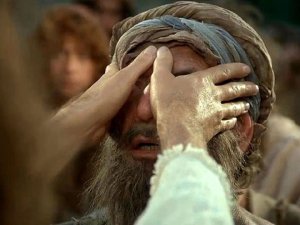
“If this man were not from God, He could do nothing.” John 9:33
This entire chapter of 41 verses concerns only one incident, namely the healing of a man born blind. Besides Jesus, those involved in the story include the blind man forced to beg for a living, the man’s parents, the disciples, the man’s neighbours, the Pharisees, and other Jewish religious leaders. All these people are forced to come to terms with who Jesus is and why He came.
The story begins with a misconception expressed by the disciples. They ask Jesus, “Who sinned, this man or his parents, that he was born blind.?” The disciples are giving voice to the common thought that suffering could be traced to sin. There is no doubt that some suffering is the result of sin. If, for example, I rob a bank (sin), and am apprehended, tried, convicted, and jailed, the imprisonment I suffer is certainly the result of my own sin. Similarly, if someone else robs that bank and in a resulting shout-out with police, I am hit by a stray bullet and wounded, I am suffering because of another’s sin. But is suffering always the result of sin? “No,” Jesus answers. In fact, “It was not that this man sinned, or his parents, but that the works of God might be displayed in him.” In this case the suffering was going to lead to people seeing that Jesus, as God, can heal. In fact, Jesus is “the Light of the world” and to reinforce that message through this healing was one of the reasons Jesus had been sent into the world (John 8:3-5).
Rather than accept the facts, it is sometimes the way of the world to question the obvious. Neighbours of the man discuss whether the man healed is really their neighbour or some stranger (vv. 8-9). The man insists he is indeed their neighbour. I like the simple faith of this man. He doesn’t question the obvious: I’m the man -Jesus healed me (vv. 9-12).
Similarly, the man’s parents provide straightforward answers to the Jewish leaders in verses 18-23. The are asked, ‘Is this your son” and ‘How does he now see? They reply, ‘Yes, he is our son and was born blind.’ When asked how their son now could see, they answered that they did not know, nor who accomplished that miracle. “Ask him” was their suggestion. Their real problem was fear that they might be expelled from the synagogue if they identified Jesus as the healer (v. 23). Their son is more honest: “One thing I know, that though I was blind, now I see” (v. 25), Then, he presses the Jewish leaders reviling him for acknowledging Jesus:
30 The man answered, “Why, this is an amazing thing! You do not know where he comes from, and yet he opened my eyes. 31 We know that God does not listen to sinners, but if anyone is a worshiper of God and does his will, God listens to him. 32 Never since the world began has it been heard that anyone opened the eyes of a man born blind. 33 If this man were not from God, he could do nothing.”
Again, I like this man. He is a witness to the person of Jesus as the Christ sent from the Father. He is a witness to Jesus and responds to the Lord: “Lord, I believe” (v. 38). He then worships Jesus. This contrasts to the Pharisees who were the real blind ones (see point 3 under “Your Turn,” below).
Your Turn:
-
Read John 9.
-
Notice the names or titles given to Jesus in this chapter: Rabbi (v. 2), a man not from God (v. 16), a prophet (v. 17), Christ (=Messiah, v. 22), a sinner (v. 24), Son of Man (v. 35). Which titles do you say truly belong to Jesus?
-
Think of the two kinds of blindness in this chapter. The Pharisees go back to an old theme of theirs when they criticize Jesus for healing on a Sabbath day (vv. 13-17), refusing to accept the testimony of the man born blind. Jesus had applied some mud to the eye of the man and that was viewed by the Pharisees as ‘working on the Sabbath’. Such legalism was more important to them than a man’s gaining sight. They, Jesus says at the end of the chapter, refuse to see – they were spiritually blind (vv. 39-41).
DAY 313 – JOHN 10: The Good Shepherd

I am the good shepherd. I know my own and my own know me, 15 just as the Father knows me and I know the Father; and I lay down my life for the sheep. John 10:14
Jesus continues to reveal Himself in chapter 10. He is the “Door” to the sheepfold and He is the “Good Shepherd” to His sheep. He explains that anyone who tries to enter the secure area of the sheepfold by any way other than the door is not the true shepherd. The sheep can tell the difference and won’t listen to thieves and robbers who have come to steal, kill, and destroy the sheep. From them, the sheep flee. The gatekeeper recognizes the voice of the Shepherd and opens the gate. Likewise, the sheep, His flock, respond to that voice and follow Him to pasture. Jesus is likened to the door itself – with authority to enter and leave – the one who has legitimate access to the sheep. “I am the Door of the sheep,” John 10:7.
More than that, He is also the Shepherd, Himself. As the legitimate shepherd, He takes care of His sheep in every way that matters. “I am the good Shepherd,” John 10:11. What does taking care of them involve?
-
Finding and sustaining the life of the sheep, v. 10
-
Lays down His life to protect the sheep, vv. 11, 15
-
Knowing the sheep and being known by them, v. 14
-
Known and loved by the Father, vv. 15, 17
-
Giving His life (His death) and taking it up again (His resurrection), vv. 17-18
In the opening verses of the chapter, as well as in the last half (verses 22-42) there are indications of how His hearers are responding to Him. First, there are those who misunderstood (v. 6) and rejected (vv. 25-26) Him. They did not get the illustration of sheep, sheepfold, and shepherd. Some even thought He was demon-possessed or insane. They rejected that He was the Son of God, the Christ (v. 24, “if you are the Christ”). They considered His claims to be blasphemy, thus grabbing stones to stone Him (vv. 31-36). They tried to arrest Him (v. 39).
But, others responded with belief (v. 42, “many believed”). To those who believed, Jesus gave the ability to recognize His voice and discern Him as shown through His miracles (vv. 4, 16, 25b). And He gave them abundant life (v. 10).
Your Turn:
-
Read John 10.
-
The obvious question is, ‘In which group are you – he rejectors or the believers?’
-
You will find a passage similar to this one in Ezekiel 34. The Lord rebukes the false shepherds of that day and speaks of a coming shepherd, in the line of David, who will feed and care for the flock.
-
The listeners who rejected Jesus, lacked understanding of the metaphor of sheep and shepherds. In Matthew 13:11-17 the Lord explained that believers had this understanding. 11 And he answered them, “To you it has been given to know the secrets of the kingdom of heaven, but to them it has not been given. 12 For to the one who has, more will be given, and he will have an abundance, but from the one who has not, even what he has will be taken away. 13 This is why I speak to them in parables, because seeing they do not see, and hearing they do not hear, nor do they understand. 14 Indeed, in their case the prophecy of Isaiah is fulfilled that says: ‘You will indeed hear but never understand, and you will indeed see but never perceive.”15 For this people’s heart has grown dull, and with their ears they can barely hear, and their eyes they have closed, lest they should see with their eyes and hear with their ears and understand with their heart and turn, and I would heal them.’
DAY 314 – JOHN 11 : Death & Resurrection

Jesus said to her,”I am the resurrection and the life.Whoever believes in Me, though he die, yet shall he live, and everyone who lives and believes in Me shall never die. Do you believe this?” John 11:25-26
This is a chapter about death and resurrection – the death and resurrection of Lazarus and the death and resurrection of Jesus.
Let’s simply consider some observations of note in these verses.
-
Lazarus died because of an illness (vv. 4,6). It was something beyond his or his loved ones’ control. Sometimes we ask, “Why?” Perhaps our loved one was younger than we might expect to face death. Lazarus’ sisters trusted the Jesus could have healed their brother if only Jesus had come sooner (vv. 22, 31). In our case, when someone dies, perhaps help was available but for whatever reason could not be reached in time. So, again we ask, “Why?”
-
Jesus knew why. Repeatedly, the passage says that Jesus delayed His arrival (vv. 6, 17-21, 32). He did so while aware of ‘why’. Verse 4 says, “This illness does not lead to death. It is for the glory of God, so that the Son of God might be glorified through it.” Jesus knew that Lazarus was dead, really dead, but He also knew that He was about to restore His friend to life. That act of restoration would point people to Jesus Himself, as Son of God. Notice v. 45: many who were present believed in Him. Jesus knows the ‘whys’ we have to face in life. Sometimes we come to know the answer, but other times we are left to trust Him even without an answer.
-
Jesus loved this family (vv. 5, 36). Jesus talked with Mary and Martha in a kindly way, explaining the nature of resurrection and was sympathetic to both (vv. 23-26, 33-35). Knowing Lazarus would very soon be alive, nonetheless, He wept (v. 35) – wept for the sisters in their grief, wept that they had (and we have) to face death, wept that their faith in Him was too limited. We see Him as compassionate and caring.
-
Lazarus rose but had to die again later (vv. 38-44). He would die later, but ultimately, he, like all other believers in Christ, would rise again to an eternal life: “Whoever believes in Me, though he die, yet shall he live, and everyone who lives and believes in Me shall never die. (vv. 25-26).
-
Jesus would die and be raised to never die again . He is the resurrection and the life. He would one day die for the people (as the High Priest observed in v. 49). He would one day rise from the dead, victorious over it. The writer of this Gospel, John, saw the meaning in what was said: “51 He [the High Priest] did not say this of his own accord, but being high priest that year he prophesied that Jesus would die for the nation,52 and not for the nation only, but also to gather into one the children of God who are scattered abroad.” (vv. 51-52)
Your Turn:
-
Read John 11.
-
Have there been times in your own life when you asked, “Why?”, but in the course of time, you came to understand God’s plan more clearly?
-
Jesus was “deeply moved” (V. 38) in all of this. It is helpful for us to recognize that Jesus loves us and does not abandon us in our sorrows.
-
Is there some way you can help another person through a crisis by being there for them, and pointing to this example of the compassion of Christ?
DAY 315 – JOHN 12: The Hour Has Come

“While you have the light, believe in the light, that you may become sons of light.” John 12:36
As we arrive at John 12, we see that Jesus is preparing Himself and His followers for what will soon transpire in Jerusalem. The time for His great sacrifice and great resurrection is near. “The hour has come” (v. 23). This hour will include six anticipatory pointers to the final steps of His obedience to the Father’s grand plan: anointing, antagonism, announcements, acceptance, and accomplishment.
-
Anointing, vv. 1-8
This first act is the anointing. Jesus and the disciples again visit His friends in Bethany. While He and Lazarus are in conversation, Martha serves dinner and Mary takes a large (and expensive) quantity of perfume (an investment worth about one year’s wages for a working man) and anoints Jesus’ feet, wiping the feet with her hair (washing a guest’s feet was not unusual but loosing one’s hair to do so was) . For this act of devotion and respect, Mary receives criticism from Judas Iscariot, who pretends to be concerned for the poor: “ ‘Why was this ointment not sold for three hundred denarii and given to the poor?’ 6 He said this, not because he cared about the poor, but because he was a thief, and having charge of the moneybag he used to help himself to what was put into it.” The Lord replies that the perfume was her way of honouring Him in His coming burial – a one-time event as compared to the cause of helping the poor which was always needed and available. The anointing pointed to Jesus’ death and burial.
-
Antagonism, vv. 9-11
The chief priests, mostly Sadducees who did not believe in a resurrection, planned to kill not only Jesus but also Lazarus who was a living testimony to resurrection. They were jealous and resentful that many believed in Jesus. This pointed to the coming religious trial and death sentence they would pronounce upon Him.
Announcements, vv. 12-19, 36b-41
There are two announcements that prepare the way to the cross and empty tomb. Both were originally made in the Old Testament scriptures. First, in verses 12-19, the triumphal entry of Jesus into Jerusalem is described. This fulfills Psalm 118:25-26 (“Hosanna! Blessed is He who comes in the name of the Lord, even the King of Israel!”) and Zechariah 9:9 (“Fear not, daughter of Zion; behold your king is coming, sitting on a donkey’s colt!”) Palm branches were used in celebratory processionals. “Hosanna” means “save now” and speaks to Jesus’ role as Messiah/King, the Saviour coming to liberate Israel, and the donkey, a symbol of peace, points to the One who enables us to be at peace with God. The disciples later understood the symbolism of this entry: “16 His disciples did not understand these things at first, but when Jesus was glorified, then they remembered that these things had been written about him and had been done to him.
Later in chapter 12, Isaiah 53:1 and 6:9-10 are quoted and form another announcement. Many still did not believe in Him, and John recalls how that had been foretold: “ Though He had done so many signs before them, they still did not believe in Him, so that the word spoken by the prophet Isaiah might be fulfilled: ‘Lord, who has believed what he heard from us, and to whom has the arm of the Lord been revealed?…’ ”
-
Acceptance, vv. 20-26, 42-43
Some did believe, both among the Jews (v. 42) and the Gentiles (vv.20-21). For some, there was still a lingering fear of the religious authorities who might suspend their synagogue privileges (v. 42). To these and all who sought Him, the Lord cautioned, saying that discipleship meant a turning away from this life and a surrender to the new life (vv. 25-26).
-
Accomplishment, 27-36a
Jesus had His own struggles with the assignment the Father had given Him (“My soul is troubled…”, v. 27), but He resolved to accomplish all that He had been sent to do: “For this purpose I have come to this hour.” He spoke of being “lifted up” (v. 32), indicating “What kind of death He was going to die” (namely, death on a cross, v.33). He called His hearers to believe in Him as the “light” (v. 36)
Your Turn:
-
Read John 12.
-
Here’s an amazing statistic that shows the ultimate importance of the final days of Jesus’ life. John opens with this reference point: “six days before the Passover” (12:1). David Guzik at https://enduringword.com/bible-commentary/john-12/
writes, “John gave a time marker, telling us that this was the last week before the death and burial of Jesus. Almost one-half of John’s Gospel is given to this last week. Matthew used more than 33% of his Gospel to cover that week, Mark nearly 40% and Luke over 25% – to seven days of Jesus’ entire life.”
-
Our part in all this will be either “antagonism” or “acceptance” (and the subsequent worship of God as shown in Mary’s “anointing”).
-
Are you willing to be a follower of Jesus regardless of opposition?
 Abundant Living