Week 48 – Days 330-336
Day 330 – John 20 – Believe

On Easter Sunday each year many churches hold a “sunrise” service. I can remember one Easter when my wife and I hosted a sunrise breakfast for our church youth group. Sunrise and Easter are linked. In John 20 we read about the first sunrise that followed Jesus’ death and resurrection.
“Now on the first day of the week Mary Magdalene came to the tomb early.” It was so early that “it was still dark” (20:3)
In the dim morning hour, she met the risen Jesus but not making out his features (especially since He was no longer in a beaten body, but rather a perfect resurrection body).
There are five resurrection meetings with Jesus recorded in this chapter: Mary Magdalene (outside the tomb), the disciple Peter (outside the tomb), John the disciple (in the empty tomb), ten of the disciples (in a locked room), and Thomas (in that room and who did not believe that day but did eight days later).Which one of these witnesses to the resurrection would you most likely have been? Mary believed when she saw Him and heard His familiar voice. John appears to have been the first to believe – and did so before seeing Jesus. Peter took a few days. The disciples as a group believed when they saw Jesus in person. Thomas needed more than their testimony.
What does it take to be convinced that Jesus is risen? Different elements seem to contribute:
- A love for the Lord, seen mostly in Mary in her persistence to have answers (vv. 11-18)
- Hearing reports from reliable sources about the resurrection (vv. 18, 25)
- Seeing and hearing Him (vv. 16-18,19-20, 26-29)
- Investigation of the evidence (vv. 5-9)
- Willingness to overcome our tendency to disbelieve (vv. 25-27)
The passage ends with a challenge: “Blessed are those who have not seen and yet have believed” (v. 29). The opportunities a person has to get to know Jesus fully will differ from one person to the next.
Your Turn:
- Read John 20.
- What do you know about Jesus? Are you willing to learn more?
- Think about the word “believe”. Merriam-Webster dictionary defines the word this way: to consider to be true, to accept something as genuine, to have a firm conviction or persuasion (about the existence of God). Do you believe in this sense about Jesus’ resurrection?
Day 331 – John 21 – Different Places
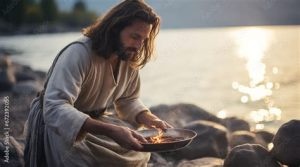
21 When Peter saw him, he said to Jesus, “Lord, what about this man?” 22 Jesus said to him, “If it is My will that he remain until I come, what is that to you? You follow Me!” John 21: 21-22
This final chapter of the Gospel of John features one of the post-resurrection appearances of Jesus to His followers – this time, seven disciples on the shores of Galilee. Jesus enables them to catch a large number of fish and prepares breakfast for them before having something particular to say to and about Peter and John. The variety of followers we see here reminds us that our paths in life will differ. Obedience to Christ may take us to different places and result in different endings to our story. Here, for example, is what we know from biblical and other sources about five of the followers (two are not named).
Simon Peter: worked at establishing the church in Jerusalem and Rome; executed by crucifixion in 64-67 AD.
Thomas the twin: took the gospel to India; helped Syrian believers who lived on the Malabar Coast in establishing the church there
Nathanael of Cana: also called Bartholomew; preached in India, Armenia, Ethiopia, and Persia; died a martyr’s death
James, one of the sons of Zebedee, was a leader in he early church in Jerusalem, and was beheaded by Herod Agrippa around 44 AD; see Acts 12:2
John, the disciple whom Jesus loved: spent some years a prisoner on the Island of Patmos; died a natural death in Ephesus, ~c.100 AD.
More is added about Peter (vv. 15-19) and John (vv. 20-24). Peter’s recent failure to identify with Christ at the time of the trials (John 15:15-18, 25-27) may be on some minds when Jesus asks Peter, three times, “Do you love Me more than these?” Peter had once boasted that he would lay down his life for Jesus (13:37), but then he failed. Now, there is no boasting, just a simple statement that says it all: “Lord, You know that I love you.” This avowal is accepted by the Lord who then challenges Peter, “Feed My lambs/sheep.” Jesus has publicly accepted Peter’s profession and given him the task of shepherding the Lord’s followers. Later in the New Testament, Peter himself challenges other elders to shepherd their congregations willingly, eagerly, in a non- domineering way, and to be good examples (I Peter 5:1-4). Peter is also told by Jesus that when he is old, others will lead him, arms outstretched, to his death (John 21:18-19). He would, indeed, be faithful to death. As for John, Peter wonders what his end will be like (v. 21). To this Jesus replies, “If it is My will that he remain until I come, what is that to you? You follow Me!” (v. 22)
Here is the lesson we need to learn. God needs His children to do His work in different places, with different outcomes, and over different lengths of time. Ours is not to compare. The important thing is that we follow Him all our days, in the service and ministry to which He calls us.
Your Turn:
- Read John 21.
- Perhaps you serve in a behind-the-scenes place while others get the glory. Are you OK with that?
- What is your primary service to Christ?
- Have you moved on from some past failure in witness to the place of service God wants you in now?
DAY 332 – The Minor Prophets: Habakkuk
“For I am doing a work in your days that you would not believe if I told.” Habakkuk 1:5a
What world events are happening right now that make you wonder – wonder why God allows these things to go on? People are starving, dying from explosives dropped on their communities, and all this havoc because two violent factions are at war, or a bully nation unjustly attacks a neighbour?
Habakkuk lived at the same time as Jeremiah, Ezekiel, and Daniel. Their homeland, Judah, was home to lots of corruption and this concerned Habakkuk. In his short book, the prophet engages with God in a back-and-forth conversation. It goes something like this:
Habakkuk: Lord, when are you going to do something about the injustices in Judah?
God: Don’t worry – I’m sending the dreaded Babylonians to come and take control.
Habakkuk: Not the Babylonians! That’s like allowing the wicked to swallow up a nation more righteous than it.
God: Be patient. Trust Me. I’ll deal with the Babylonians in time.
Habakkuk: You dealt with the wicked in past days. I will trust You. Though things may look bad I will find my joy in the God of my salvation.
God’s challenge to Habakkuk is summed up in chapter 2:4b, “The righteous shall live by his faith.” The apostle Paul remembered this verse in these passages:
Romans 1:17, “16 For I am not ashamed of the gospel, for it is the power of God for salvation to everyone who believes, to the Jew first and also to the Greek. 17 For in it the righteousness of God is revealed from faith for faith, as it is written, “The righteous shall live by faith.”
Galatians 3:55-6, 5 Does he who supplies the Spirit to you and works miracles among you do so by works of the law, or by hearing with faith— 6 just as Abraham “believed God, and it was counted to him as righteousness”?
Ephesians 2:8, For by grace you have been saved through faith. And this is not your own doing; it is the gift of God…
God’s answers to the prophet’s questions were difficult for Habakkuk to accept, but in chapter 3, he reflected on earlier works of God on behalf of His faithful ones and sees that his God can be trusted.
Your Turn:
- Read the Book of Habakkuk (it’s only three chapters).
- What do you question God about?
- Are you willing to be patient and trust God to do the right thing at the right time?
- What in the world troubles you so much that you wonder why doesn’t God intervene?
Day 333 – The Minor Prophets: Joel
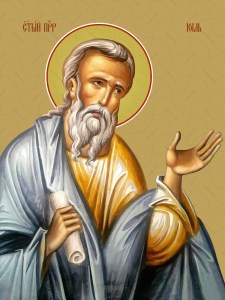
https://psdsale.com/en/shop/apostoly-i-proroki/prorok-ioil-10156
Joel 2:28-32
28 “And it shall come to pass afterward, that I will pour out my Spirit on all flesh;
your sons and your daughters shall prophesy, your old men shall dream dreams,
and your young men shall see visions. 29 Even on the male and female servants
in those days I will pour out my Spirit.30 “And I will show wonders in the heavens and on the earth, blood and fire and columns of smoke. 31 The sun shall be turned to darkness, and the moon to blood, before the great and awesome day of the Lord comes.32 And it shall come to pass that everyone who calls on the name of the Lord shall be saved.
Acts 2:17-21
“‘And in the last days it shall be, God declares, that I will pour out my Spirit on all flesh,
and your sons and your daughters shall prophesy, and your young men shall see visions, and your old men shall dream dreams;18 even on my male servants and female servants in those days I will pour out my Spirit, and they shall prophesy.19 And I will show wonders in the heavens above and signs on the earth below, blood, and fire, and vapor of smoke;20 the sun shall be turned to darkness and the moon to blood, before the day of the Lord comes, the great and magnificent day.21 And it shall come to pass that everyone who calls upon the name of the Lord shall be saved.’
These passages, as you can see, are almost identical. In Acts 2 the Apostle Peter is speaking to a crowd who had come together on the day of Pentecost (50 days after Passover and shortly after the ascension of the risen Lord Jesus). Jesus had promised that the Holy Spirit would come upon believers and empower them to be witnesses pointing others to Jesus (see Acts 1:8). So, they gathered and the Spirit came upon them with the sound of wind while something the looked like tongues of fire rested upon them. They began speaking in languages they did not know but which observers recognized as their native tongues. These observes wondered what was happening (Acts 2:1-13).
That’s when Peter spoke on behalf of the disciples and explained that what was happening had been predicted by the prophet Joel almost 600 years earlier. He quoted Joel 2:28-32 (above). Joel’s prophecy pointed to the coming of the Holy Spirit upon believers. The Spirit would enable them to proclaim the gospel – the message about Jesus and His death on our behalf followed by His resurrection. The last verse of the quoted passage says, “And it shall come to pass that everyone who calls on the name of the Lord shall be saved.”
Joel’s book predicts coming judgement (a locust invasion and an army invasion, 1:1-20; 2:1-17) on Judah as well as God’s mercy (restoration from exile back to their homeland, 2:18-32). Then he tells of future judgment of bordering nations (3:1-16) and a great future for Judah (3:17-21). He uses the term “the day of the Lord”, both for the near future when Judah is restored and the ends times. Somewhere in the middle was Peter’s time when God’s people would share the account of Jesus’ coming and invitation. In both cases, God urges people to return to the Lord with all their heart (2:12). Peter gave the same invitation in Acts 2:38, “Repent and be baptized every one of you in the name of Jesus Christ for the forgiveness of your sins, and you will receive the gift of the Holy Spirit.”.
Your Turn:
- Read the Book of Joel.
- Note: There are many treasures in the Old Testament which had application in New Testament times and in the day in which we live. The empowering of the Spirit is as available today as at other times in history – available to young and old, and sometimes accompanied by signs in nature (2:28-31).
- Consider these verses where we are urged to serve God in the power of the Spirit.
But the Helper, the Holy Spirit, whom the Father will send in my name, he will teach you all things and bring to your remembrance all that I have said to you. [This is Jesus speaking in John14:26.]
Likewise, the Spirit helps us in our weakness. For we do not know what to pray for as we ought, but the Spirit himself intercedes for us with groanings too deep for words. Romans 8:26
And do not get drunk with wine, for that is debauchery, but be filled with the Spirit. Ephesians 5:18
In Him you also, when you heard the word of truth, the gospel of your salvation, and believed in Him, were sealed with the promised Holy Spirit, who is the guarantee of our inheritance until we acquire possession of it, to the praise of His glory. Ephesians 1:13-14
DAY 334 – The Minor Prophets: Obadiah
 eternalbible.org
We have heard a report from the Lord, and a messenger has been sent among the nations. Obadiah 1:1
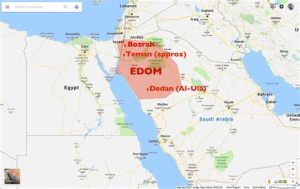
Obadiah was a prophet based in /Judah around the late-eighth century B.C. His book is all about God’s coming judgment on the nation of Edom. Edom is often mentioned in the Bible. What follows is an introduction to Edom, taken from the enduringword.com commentary, written by David Guzik:
Obadiah’s prophecy is unique because he doesn’t deal with Judah or Israel much at all. His focus is on the sin of Edom and the judgment coming upon them. Who were the Edomites?
- The Edomites were the people descended from Esau, the son of Isaac and Rebekah and the brother of Jacob (Genesis 25:19-34). Esau was nicknamed “Edom” (which means, “red”) probably because he had red hair.
- Esau eventually settled in the area of Mount Seir and absorbed a people known as the Horites (seeGenesis 36:8-43, which refers to Edomite rulers asdukes in the King James Version).
- When Israel came out of Egypt and wanted to pass through the land of the Edomites to enter into the Promised Land, the Edomites wouldn’t let them (Numbers 20:14-21).
- The Edomites opposed Saul and were conquered under David and Solomon (1 Samuel 14:47,2 Samuel 8:14,1 Kings 9:26).
- In the days of King Jehoshaphat of Judah, Edom joined with Moab and Ammon to attack Judah, but the Lord fought for Judah and defeated them (see2 Chronicles 20:1-27, which describes the famous battle that was led with praise).
- The Edomites successfully rebelled against King Jehoram of Judah (2 Kings 8:16-22).
- King Amaziah of Judah brought them back under subjugation (2 Kings 14:9-11).
- The Edomites again attacked Judah in the days of King Ahaz (2 Chronicles 28:17).
- The Edomites fought side by side with the Jews in the rebellion against Rome in A.D. 66-70 and were crushed by Rome, never to be heard of as a people again. The predictions of Obadiah 1:10 and 1:18 were proven true.
In chapter 1, the prophet says that God will bring Edom down (1:4) . Reasons for this coming judgment are offered – e.g., pride (v.3) and violence done to Judah (v. 10). From 1:12-14, God delivers a list of “do nots” – what Edom should not be doing: do not gloat, boast, loot, stop refugees at your border, hand over to invaders Jewish survivors. On the positive side, to Judah God assures them that what their enemies (including Edom) will suffer in the same way they have caused Judah to suffer (v. 15). Judah shall repossess territories previously taken from them (v. 17). These territories are listed in verses 19-21 (Mount Esau/ Mount Zion, Philistia, Ephraim, Samaria, Gilead, Canaan, the Negeb).
Your Turn:
- Read Obadiah.
- Just as Edom had been guilty of much wrongdoing, so, too, in our day there are nations (and their selfish, non-caring leaders) committing wrongs on people from other countries, languages, ethnic groups, etc. These “bully nations” and their leaders show the same pride, gloating, violence, looting of others, blockage of refugees, etc. Think of examples. Will God forever ignore such ill treatment?
- Does God take note of the evils one nation or people group inflicts on another?
- If you were to apply the message here to us as individuals, would we find any evidence in our lives of unjust treatment of others?
DAY 335 – The Minor Prophets: Haggai
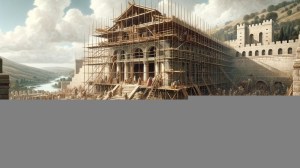
“Consider your ways” Haggai 1:5,7
I’m sure you have wondered at times why God does not intervene directly in this world. Of course, He has in the past – the Red Sea parted, the sun stood still, etc., And, here in the Book of Haggai, God reveals that He has been controlling nature, influencing the economy, etc.
Haggai was a prophet based in Judah in the 6th century B.C. His book consists of only two chapters and can be understood by four dates on the calendar.
August 29, 520 B.C. – Haggai1:1-11
On this date, “the word of the Lord came at the hand of Haggai the prophet” (1:1) Haggai addressed the governor of Judah and the high priest. And the message from God was that the people were focussed on their own comforts, dragging their feet on the rebuilding of the temple in Jerusalem (which had been destroyed by King Nebuchadnezzar of Babylon on July 29, 587 B.C.), and as a result were experiencing poor harvests and financial losses (1:6). The Lord challenges the people, “Consider your ways” (1:5,7). He expects them to gather materials for the rebuilding of the temple, a temple that would bring glory to God (1:8). He states clearly that because they have spent their time and money on self-comfort, and neglected the temple, He has brought drought upon the land (1:10-11). So, God sometimes does intervene in ways that are meant to deliver a message.
September 21, 520 B.C. – Haggai 1:12-15
What was the result? Led by the governor and the high priest, the people obeyed God and got busy with the rebuild (1:12, 14). So, that was a good response!
October 17, 520 B.C. – Haggai 2:1-9
Then the Lord gave Haggai another message. There were older folk who would see this new temple and not feel like celebrating because it would not have the grandeur of Solomon’s temple (1:3). God’s reassurance to these people comes in these words: be strong, I am with you, My Spirit remains in your midst, fear not, I will shake the heavens and the earth and the sea, I will fill this house with glory, I will shake all nations, this house will be greater than the former, and in this place, I will give peace! Those are quite powerful words. When would all that happen? “in a little while” (2:6). God’s sense of time is different from ours. “… with the Lord one day is as a thousand years, and a thousand years as one day” (II Peter 3:8). There is no doubt that in some ways the change being described applied to the near future in Haggai’s time and in other sense, the application is to a future time (as is being talked about in Hebrews 12:26-28 where the Haggai passage is used).
December 18, 580 B.C. – Haggai 2:10, 20
God reminds the people of the scarcity they experienced was judgment for their misguided selfish investments, but ends with the promise, “But from this day on I will bless you.” (2:19) – i.e., from the day of their obedience to invest in God’s temple. The book ends with a promise to restore the strength of the kingdom under the reign of David’s descendant. Initially, this is Zerubbabel, but long term, it is a Christ and the “day” referred to is the future Day of the Lord.
Your Turn:
- Read Haggai, chapters 1 and 2.
- Could it be that some of the losses we experience today are disciplinary judgments from God for our self-centred lifestyle and neglect of God’s house?
- Notice that God’s glory is diminished in the sight of others by the sins of those who identify as His people.
- What turnarounds does God expect of us? See how in the space of just four months the people of Judah moved from disobedience and discipline to obedience and blessing.
DAY 336 – The Minor Prophets: Zechariah
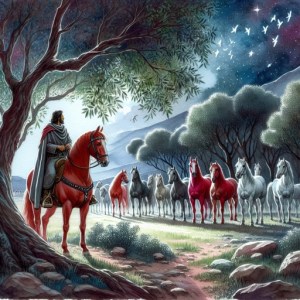
Thus says the lord of hosts, “ Return to me, says the lord of hosts, and i will return to you, says the lord of hosts.” Zechariah 1:
Zechariah is an interesting and exciting book, with vivid pictures and dramatic events found in its 14 chapters. The first chapter alone contains eight visions which occurred in one night – did Zechariah get much sleep that night? The setting is the same as found in Haggai, in 520 B.C.
The book begins with, in a sense, a summary statement: if the people repent, God will be with them. Then, there is the first vision of horsemen.
- Vision #1 (1:7-12) – the horsemen are sent out by the Lord to patrol the earth and to report back. They find the earth at rest while Jerusalem is still in a defeated state. It’s been seventy years since Judah was taken captive. God says it’s now time for Him to extend His mercy and see that Jerusalem and the temple in it are rebuilt. Succeeding visions reinforce this message.
- Vision #2 (1:18-21)– powerful nations (represented by horns), nations that subject Judah, will be defeated and the Jews will dwell safely
- Vision #3 (2:1-13) – a man with a measuring line measures the future Jerusalem and finds it will be very large – so much so that it reaches beyond its walls. God’s glory would be present.
- Vision #4 (3:1-10) – Joshua, the high priest, is wearing filthy garments and is accused by Satan, but God tells some angels to give Joshua clean clothes. God also promises to send His servant, the “Branch”, to completely remove the nation’s sins. The Branch, of course, is Jesus. Jeremiah 23:5-6 says likewise:
- 5 “Behold, the days are coming, declares theLord, when I will raise up for David a righteous Branch, and he shall reign as king and deal wisely, and shall execute justice and righteousness in the land. 6 In his days Judah will be saved, and Israel will dwell securely. And this is the name by which he will be called: ‘The Lord is our righteousness.’”
- Vision #5 (4:1-14) – Zechariah sees a lampstand with lamps attached and two olive trees nearby. Olive oil supplied two bowls which held fuel for the lamps. A message is given to Judah’s leaders, namely that God’s Spirit would give them the power to complete the task of building the walls: “Not by might nor by power but by My Spirit, says the Lord of hosts” (v. 6) The project of rebuilding Jerusalem’s walls might start small (“the day of small things,” v. 10), but would be completed.
- Vision #6 (5:1-4) – Next, we are told about a gigantic scroll, 30’ X 15’, that contains a list of sins committed against others (like theft) and against God (like swearing falsely). God would judge such sins.
- Vision #7 (5:5-11) – The prophet sees a basket with a heavy covering. Inside is a woman, who personifies evil. She is carried away to a distant land. The symbol is of evil being removed from the land of Judah.
- Vision #8 (6:1-8) – This vision, like the first, features strong horses. Here, the horses (red, black, white, dappled) pull four chariots toward the north and south, from where Israel’s enemies primarily came. They patrol the earth and establish God’s rule wherever He sets His Spirit (v. 8).
You can see from these visions that God is aware of sin and the need to overcome it. He is able to overcome evil and establish righteousness by His Son (the Branch) and His Spirit. In the remaining chapters more detail is offered about the nature of sin, its presence in individuals and nations, and of God’s plan to establish justice on the earth. References are made to the coming of Jesus Christ, both His first coming and His return (chapters 9 through 14.
Look at these verses that find fulfilment in the New Testament:
9:9, “Rejoice greatly, O daughter of Zion! Shout aloud, O daughter of Jerusalem! Behold, your King is coming to you, humble and having salvation is He. Humble and mounted on a donkey, on a colt, the foal of a donkey.” See Matthew 21;5, John 12:15).
11:12-13, “. 12 Then I said to them, “If it seems good to you, give me my wages; but if not, keep them.” And they weighed out as my wages thirty pieces of silver. 13 Then the Lord said to me, “Throw it to the potter”—the lordly price at which I was priced by them. So I took the thirty pieces of silver and threw them into the house of the Lord, to the potter. “ See Matthew 27:9.
12:10, “And I will pour out on the house of David and the inhabitants of Jerusalem a spirit of grace and pleas for mercy, so that, when they look on me, on him whom they have pierced, they shall mourn for him, as one mourns for an only child, and weep bitterly over him, as one weeps over a firstborn.” See John 19:37; Rev. 1:7.
13:7b, “Strike the shepherd, and the sheep will be scattered;
I will turn my hand against the little ones.” See Matthew 26:31 and Mark 14:27.
Your Turn:
- Read Zechariah chapters 1-6.
- Think of the many evils done in our world, including those inflicted by one nation on another. Does God see these? Has He in the past put an end to hurtful regimes? Will He one day make things right?
 Abundant Living